Monday, December 10, 2007
Breakfast at Tiffany's Part II

Breakfast At Tiffany's Pt 2
In spite of Holly's attempts to be live a non-commital lifestyle in order to be 'free' and 'wild' she has only committed herself to a way of living in which she obliges herself to make costly sacrifices. Her decisions force her to commit to abandoning the things and people she becomes close to that is if she becomes close at all. This could explain the way people question her as a phony.
Her happiness may be a facade, just as the role she played when she told her cat to "fuck off" and "beat it." It's as though her life is one big role she's acting out; she is being tough to cover her vulnerability, maybe even to cover the traces of remorse she has for committing to the lifestyle she lives. Also, if she sees other people believing her free, wild and happy-go-lucky or Holly Go-Lightly facade then she can feel like maybe it is true. When she projects herself this way and other people believe it she is able to believe it herself.
Sunday, December 9, 2007
The "Wild Thing"
But the reason for this phobia is only made clear near the end of the tale; Holly is a self-proclaimed “wild thing” and cannot let herself be caged in any way. After her husband, Doc Golightly, comes to New York to reclaim her, she explains to Joe Bell, “[n]ever love a wild thing Mr. Bell…That was Doc’s mistake. He was always lugging home wild things. A hawk with a hurt wing…But you can’t give your heart to a wild thing: the more you do, the stronger they get. Until they’re strong enough to run into the woods. Or fly into a tree”(74).
Holly was just another wild thing Doc had lugged home. Once he had made her strong, she had no option but to flee. She could not be tied down and tamed by a simple life in the country and so she fled. She had little choice, which the Doc presumably understands; it is simply her nature. She is like the hawk: a “wild thing.”
Response
Capote's ending rang true for me because I felt that it captured the reality of human interaction, the way people move in and out of each others lives. But most importantly, the ending seemed in some way plausible. Not the fact that Holly ran off, dramatically escaping from jail to fly to Brazil, but the fact that she pulled through. She was tough, like her cat, and though at times she revealed just how fragile she really was (reading Jose's letter for example), she still struggled through overwhelming odds and lived her life the way she wanted. And that to me is more interesting and heartbreaking than lovers meeting in the rain.
If Holly Golighty is a “real phony,” it’s very hard to tell which parts of her are real and which are phony. Perhaps because “she believes all the crap she believes,” she seems as though she’s been the Holly of now forever. The past that creeps silently beside her inspires a mystery; how will she react when faced the history she refuses to acknowledge? Will it bring out her realness or phoniness? She appears destined to eternally evade the question until her ex-husband comes looking for her. Surprisingly, Holly does not run from the confrontation; like every other odd aspect of her life, she embraces him with warmth. In the revelation of her storied pre-New
Saturday, December 8, 2007
Kamala's Post
Posting for Monday, December 10th, 2007
As I read Truman Capote’s, Breakfast at Tiffany’s, I realized that the character Holly Golightly is representative of countless individuals who move to New York City in hopes of fulfilling their dreams. As I write this, there are people all over the world preparing to come to New York City to seek success in a myriad of ways. New York City is a beacon to many because it offers a unique freedom to its inhabitants. The physicality of the city; the small apartments combined with a vivid street life create an on going theatre which encourages, and allows its inhabitants to literally “cast” a role and act it out (if they so desire, and many do.) Due to its diversity of culture, New York also provides an illusion that one is constantly traveling –without departing the city. From one neighborhood to another – Chinatown to Little India in the East 20s for example, an individual can literally journey from China to India without leaving the city. In Breakfast At Tiffany’s, Holly can escape her past and create a new identity because she lives in New York City. Her sophisticated bearing (her looks and her diction) provide her entrée into the social circles of sophisticated and wealthy New Yorkers. At one point, “Fred” compares Holly to an old acquaintance of his; saying they both “….would never change because they had been given their character too soon, which like sudden riches lead to a lack of proportion” (55). Irregardless of the many people buzzing around her, Holly’s character is actually insatiable. Despite her many social connections, she remains empty –a person literally constructed in thin air. Without the backdrop of New York City, Holly would not exist. Her material gains; money, possessions and social connections do not connect her to others. It is the City that comforts Holly because it merely demands Holly’s presence. As Holly said; “I love New York, even though it isn’t mine, the way something has to be, a tree or a street or a house, something anyway, that belongs to me because I belong to it”(80). With New York City as her backdrop, Holly actually became someone.
Tiffany's cont.
Friday, December 7, 2007
Breakfast at Tiffany's: Holly as the Outsider concluded
Monday, December 3, 2007
Breakfast at Tiffany's: Holly as the Outsider
Breakfast at Tiffany's
To relate to to general theme of the class, she's an outsider of NYC, and here she is experiencing what cannot be described. I've lived in New York all my life, and as we read along I can get input into the heads of those whom surround me. Many fellow students aren't from New York and are having a difficult time situating themselves here. Holly seems to be fitting in just fine, from the outer looks of it, though she's a little torn I feel.
Someone wrote in a previous Blog that New York doesn't really have any outsiders, because outsiders is what makes New York, New York. And I thought that to be so true. Its such a great way to see it.
Breakfast At Tiffany's
Sunday, December 2, 2007
Only in the City
Holly
Holly's personality is only emphasized by New York City. She embodies the many sides of the city, being an outsider, but one who has adapted to fit in, as much at place as any native. She is beautiful but tough, kind but crooked. She is a study in contradiction, but at the end of the day there is this elusive, ephemeral quality of one who can never be caught, the quality that we love about the moving, changing city, that we also love about her.
Holly Golightly
b AT t's and some memories
Breakfast at Tiffany's
for 03 december 07
Kamala's Post 12-3-07
Post for Monday, December 3rd, 2007
In Truman Capote’s, Breakfast at Tiffany’s, we are introduced to Holly Golightly by “Fred”, who recounts that he became an authority on her existence by the mere act of “…observing the trash basket outsider her door”. Holly comes alive through Fred’s musings; her “… regular reading consisted of tabloids and travel folders and astrological charts; that she smoked an esoteric cigarette called Picayune's; survived on cottage cheese and Melba toast”(15). In this story, Capote perfectly illustrates the curious intimacy –and disengagement- between strangers which easily occurs in a city like New York. Perhaps the story is truly about Fred’s desire, and fantasy for Holly and his loneliness. Although New Yorkers live in close quarters, neighbors are privy to the most basic aspects of life. In observing the minutiae of their neighbor’s daily activities, they begin to think they know them –when in actuality they don’t –perhaps the core point of Capote’s story. When Capote describes Holly Golightly as “…such a goddamn liar, maybe she don’t know herself anymore” (30), he illustrates the illusion of her life and the potential for New Yorkers to live a life of illusion. The constant motion of Holly Golightly’s life and how she remains unknown to everyone illustrates Capote’s cynical take on life in New York. As Holly Golightly flits in and out of people’s lives, she charges in and demands that people pay attention, but only for a moment. When she leaves, it as if she wasn’t there to begin with and therefore a palpable loneliness permeates the story. Interestingly, the movie version of Breakfast at Tiffany’s glamorized the story and bypassed the loneliness of the book. On screen, it was more magical and accepted as a fantasy. New York City is essentially a small world comprised of many neighborhoods. Capote succinctly describes how its streets provide gateways for people to “run into each other” and yet also keep fantasy alive. Fred becomes a poignant character in the story when he notes that he’s “…been walking in the streets going on ten or twelve years, and all those years he’s got his eye out for one person, and nobody’s ever her”(9).
In the novella Breakfast at Tiffany’s by Truman Capote, characters drop in with their quirks quite evident but their backgrounds a mystery. The most important example has to be Holly Golightly herself, a whiplash of eccentricity and intrigue. To get to know who she is and who she was, the reader must pick up bits of information here and there, much like the narrator uses the contents of her garbage to gather some idea of her life. What is clear is that Holly is very interested in other people, an extremely social person, but does not wish to share her full story with anyone. She let loose facts with explanation, the present without the past. She’ll tell you about her brother named Fred, her visits to Sing-Sing, her love for Tiffany’s, but ask for information she doesn’t offer and she closes off. “Like many people for volunteering intimate information, anything that suggested a direct question, a pinning down, put her on guard,” narrator Fred observes. Her behavior seems typical of one who is determined to define herself on her own terms, someone who has chosen a new direction. This attitude isn’t unique to Holly; in fact,
Monday, November 26, 2007
A hundred years hence, or ever so many hundred years hence, others will see them,
Will enjoy the sunset, the pouring in of the flood-tide, the falling back to the sea of the ebb-tide.
It avails not, neither time or place—distance avails not;
I am with you, you men and women of a generation, or ever so many generations hence;
I project myself—also I return—I am with you, and know how it is.
Just as you feel when you look on the river and sky, so I felt;
Just as any of you is one of a living crowd, I was one of a crowd;
Just as you are refresh’d by the gladness of the river and the bright flow, I was refresh’d;
Just as you stand and lean on the rail, yet hurry with the swift current, I stood, yet was hurried;
Just as you look on the numberless masts of ships, and the thick-stem’d pipes of steamboats, I look’d.
These lines represent how this poem represents the Brooklyn Bridge most in my opinion. Even though the poem was written before the bridge existed and therefore, obviously doesn’t mention the bridge the concept of connection is the link. The individual is connected to other individuals and connected to the crowds in the city. Also there is a connection literally from one borough to the the other and a connection of the past and the future. By saying ‘you’ do something just as ‘I’ do there is an even deeper connecting than the physical crossing and spacial relationship because it mentions the shared feelings as well. The feeling of being refreshed by the ‘gladness’ of the river. A human relationship is formed thanks to a literal and symbolic connection and a physical and spiritual connection.
Sunday, November 25, 2007
John Marin's Brooklyn Bridge

John Marin’s etching, Brooklyn Bridge (1913), distinctly and immediately conveys the famed hustle of life in New York City. The cars on the road appear to fly over the bridge, whose structure shakes and surface warps in the tumult. The sky is filled with movement from sweeping cuts and patches of cross-hatching, while a sole pedestrian is huddled up as he scuttles across the span, clutching at his jacket and the railing for support.
This seems to suggest a change in times, with the speeding cars leaving the pedestrian standing still. Marin had returned to New York from a sojourn in Paris only two years prior to the completion of this work, and the introduction of motorcars must have seemed to multiply the energy of the notoriously bustling city exponentially.
But even before this advancement in technology, the bridge was the symbolic and literal embodiment of movement, change, and (technological) progress in the city. It opened up the greatest city in the world to itself, creating an energy that catapulted America into the twentieth century and consequentially into Marin’s work.
The Brooklyn Bridge

It is easy to take man-made structures like bridges and buildings for granted if one was not around to see man make them. The more extraordinary the structure, the more likely it seems to have appeared from the air, fully formed. The
1.
The photograph captures the architectural grandeur of the structure, the wide expanse of sky, the city on the opposite bank, and also an American family making their way over the boardwalk. The image that I believe this picture suggests, as well as the image that was presented in the opening ceremonies through the involvement of the city's mayor and borough presidents as well as the reading of Walt Whitman's "Crossing Brooklyn Ferry," is the symbol of classic America. This seems to have been built to give Americans a focal point of pride, it symbolizes achievement, possibility, and in some ways (though this may be a stretch) the American Dream. The poem, "Crossing Brooklyn Ferry" compels the reader to really look at the passage of time and space looking over New York. Whitman uses this sense of infinity, describing the sights minutely yet remarking on how other will see these same sights hundreds of years hence to pull the reader into a feeling of strange companionship. The reader, looking at these sights, is connected with the hundreds of thousands of people who have seen the same sights and will see these same sights. In some ways, I believe that the people at the opening ceremony wanted men and women walking across the bridge to feel connected to a larger, grander picture than just a practical, man-made structure thrown over a river. They wanted the people walking on that bridge, looking at that bridge to feel a connect when they saw those towers.
Misinterpretation in "Crossing Brooklyn Ferry"
Kamala's Post
Posting for Monday, November 26th, 2007
Question # 2
At first glance, Walt Whitman’s poem, “Crossing Brooklyn Ferry” seems to be an ode to the Brooklyn Bridge and New York City. But as Haw so clearly describes in his introduction, “Culture, History, and the Brooklyn Bridge”, the meaning of the Brooklyn Bridge is “…subject to the vagaries and individual perceptions” of all. In taking the reader beyond a literal interpretation of the poem, Haw proposes that the reader consider that two sides exist with to the representation of the Bridge: the physical and the “…cultural bridge of the mind and the imagination”. Understandably, many readers (including myself) have applied Whitman’s poem to their personal image of the Brooklyn Bridge and what it means to New York City i.e. this grand, sweeping arc connecting one borough to another in a sweep of iron elegance. Every New Yorker who has walked, or driven over the Brooklyn Bridge has“… absorbed, made sense of and sought to present the bridge”. In “Crossing Brooklyn Ferry” Whitman therefore utilizes physical places in New York City (such as the bridge) to communicate how landmarks connect the cities inhabitants with each other within the city. Whitman shows this connection in the poem, “Others will see the shipping of Manhattan North and West, and the heights of Brooklyn to the Southeast” (139).When Whitman poses the question in his poem, “What is then between us?” (141) this coincides with Haw’s idea that the bridge may be subject to all kinds of interpretations and meanings. At the same time, the sheer physical presence of the Brooklyn Bridge keeps it grounded and subject to the various representations. A reinforcement of this idea is found in the verse, “The same old role, the role that is what we make it, as great as we like”(142) The Brooklyn Bridge then can symbolize each one of us as being a unique landmark in a city of millions.
Response # 2
Technocratic Triumphs: 1
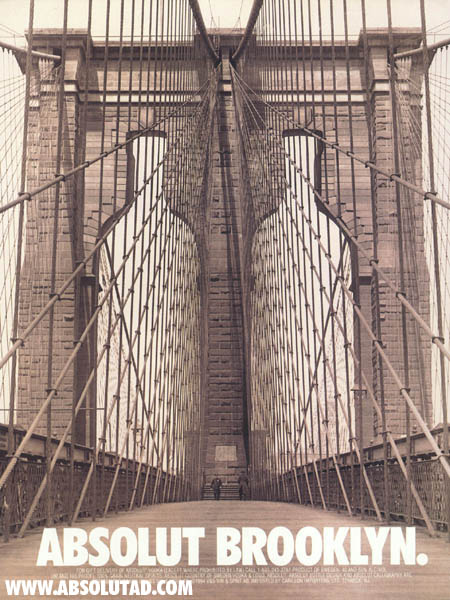
American culture is replete with images that hold strong meanings in the psyche of the public. Images of the World Trade Center on 9/11 bring up utter sadness, a portrait of George Washington utters America’s beginnings, and one of the Washington Monument shows the efficacy of American democratic government. Images like these can be used in different forms of media to relay their accordant emotions, having George Washington peddle cars for a 4th of July sale or pushing the war in Iraq with visible remembrance of the atrocity of 9/11. Another famous image that has been ingrained in American society is the Brooklyn Bridge, which Martin Filler, as quoted by Richard Haw, “has received ‘virtually unanimous critical acclaim.’” The Brooklyn Bridge stands for a multitude of things: Brooklyn and its advancement, America’s technological aptitude, and concurrent themes like freedom and democracy. As Haw says, it’s been used to hawk such items as “Royal Baking Powder, Lydia E. Pinkham’s Vegetable Compound, Williamantic Six-Cord Spool Cotton,” and more recently “Absolut Vodka.” The ad for Absolut calls upon sentiments of American solidarity, with Absolut being as important to society’s drinking as the Brooklyn Bridge is important to Brooklyn.
Saturday, November 24, 2007
Brooklyn Bridge
As Haw's writing expresses, the Brooklyn Bridge had its fair share of media help on its path to becoming a main American attraction. Sometimes the reputation, mysteriousness, and sheer enormity of a thing can create for it a reputation that may not be an appropriate approximation of the things itself. But when it comes to Whitman's poem, Crossing Brooklyn Ferry, all the elements of creativity and mysticism associated with bridge were present in abundant detail. And the fact that the bridge itself is not mentioned physically doesn't appear to be a problem as it is more than adequately represented spiritually. The ferry and its surroundings represent the same sense of completeness and connection that the bridge does. The poem speaks of posterity, and the similarity of strangers as they all travel the same path. Whitman's poem brought out that which was best in the connection of Brooklyn to greater New York (whether it be via ferry or bridge), and that feeling of innovation and prosperity was inevitably endowed in the memory of the structure.
Monday, November 19, 2007
Living in New York City’s ‘pale’ underground could turn a man into a moth.
“Then he returns to the pale subways of cement he calls his home.”
The Man-Moth makes his home in the subway riding back and forth night after night and occasionally he emerges to the surface and ‘scales’ the outdoor tunnels of cement which don’t provide enough protection from the earth’s atmosphere for him.
“He thinks the moon is a small hole at the top of the sky, proving the sky quite useless for protection.”
In Manhattan you are inside even when you’re outside, without the lid. The concrete ground rises up around you high into the atmosphere. As you scale through the outdoor tunnels you look up to the sky beyond the buildings to see traces of the sun and the moon with almost no chance of stars. It doesn’t provide enough protection for a moth, but for a man it sounds almost like a cage. Living in the ‘World Capital’ as Jonathan Lethem puts it appears to me like putting ourselves into a cage similar to the cages we put the other animals on earth we consider ourselves superior to. If we make the deepest darkest part of that cage our home we may adapt like the Man-Moth, left only with our tears, our last piece of humanity; there is always water if you dig deep enough underground.
“Then from the lids one tear, his only possession--if you watch, he’ll hand it over, cool as from underground springs and pure enough to drink.”
Subways
Sunday, November 18, 2007
#1
Subway Underworlds
The Inhuman Underground
The Man-Moth sees the moon in a different light. He is inhuman, a creature of the underground. His masculinity, his fearful longing for rebirth, and his tear all exhibit some inkling of humanness, but his subterranean dwelling is characterized as inherently inhuman. His home is a “pale [subway] of cement,” a place of “artificial tunnels” and the unnaturally abrupt start and stop of trains.
In contrast to the facades, bathed in moonlight, his home is inorganic; it is poisonous to the point that he must keep his hands in his pockets lest his glimmer of humanity seep from them, just as “others must wear mufflers” to keep the cold from stealing their human warmth.
But there is something of the subway that is human: the Man-Moth gives forth a tear from his black eye, his sole effect of humanity. He is selfish if “you’re not paying attention,” and will swallow it again, but if “you watch, he’ll hand it over.” The tear is not unnatural or poisonous, but “cool as from underground springs and pure enough to drink.” This tear is not like the strange moonlight or the hard cement, but liquid, and only attainable “if you catch him,” if someone is in the subway. Bishop seems to tell us that it is people that give the subway its human character.
The subway ride may be the longest time New Yorkers inhabit the same area at once. Of course there are few places in the city where one is not sharing space with others, but the subway is the only place where one is forced to stop moving and just be, along with everyone else. The pause provides an opportunity to make an impression. Normally New Yorkers are too focused on their own journey, traveling at their own pace. But on the subway, they are bound up with each other just long enough to notice other people. Jonathan Lethem describes a “right” of “invisibility” that every subway rider assumes he has. But the assumption stops in the subway, because eventually one will realize that he is being noticed as well. Below ground, one doesn’t try to be invisible so much as one tries not to stand out. The “irritation and panic [of the passengers] rises at each sign of oddness…” Lethem says. This oddness doesn’t need to be typically bizarre behavior; it doesn’t even need to be connected to insanity or danger. Oddness is just standing out.
11/19/07-#1
#1
Still, no one smiles. Not that thats chaotic, but Bishop describes how he misses people smiling. In NYC, however, no one has the time to smile, or go out of there way to be nice.
NYC is described in stereotype (mostly truth) as a heartless place. If you get in the way, you very well may get trampled. But what you find when you live here, or spends a lot of time here, is that there is quite a realm of respect. True New Yorkers know that others have places to go. they know not to get in their way as long as they don't get in theirs. They are respectful in not bothering anyone else because we all have a place to go and don't have time deal with some idiot walking on the wrong side of the sidewalk, or stopping right in the goddamn middle to look at a really tall building. ITS A BUILDING!!!!! Its not that freakin special.
Speak, Hoyt-Schermerhorn
Topic # 1
"In truth, every subway rider is an undercover officer in a precint house of mind, noticing and cataloguing outre and dissident behavior in his fellow passengers even while cultivating the apparent indifference for which New Yorkers are famous, above and below ground." But Lethmen also writes that New Yorkers cultivate their indifference in the subway, this shows that they bring their same sentiments underground as they do above. Lethmen also notes that subways are often spots for criminal activity, he lists ways to avoid trouble by looping and exiting the train at the last moment. along thew same lines as everyone being an undercover officer in the subway he notes that as a child him and his friends would come "spies, on the adults, the office wotrkers, tourists, beggars, and policemen who'd share segments of [their] endless trip." There is also an immense amount of history at every stop as Lethmen lets us know about the Hoyt street stop in Brooklyn, such things as "ghost platforms." Fpr example if you take the 6 local to Brooklyn Bridge City Hall and don't get off when you are prompted to you will end up in the old city hall station which is grand but abandoned, a "ghost station," before you change tracks to go back uptown.
Kamala's Post
Posting for Monday, November 19th, 2007
Question # 1
In Jonathan Lethem’s memoir “Speak, Hoyt Schmerhorn” he elegantly and evocatively describes the merging of the public and personal space within subway stations. A major point of his piece is how the subway “…station itself gave testimony to the lost commercial greatness of the area” (73). I related strongly to Lethem’s observations about the neighborhood, the station and the trains themselves both from the practical level as a lifelong subway rider, and for sentimental reasons. As a child and teenager, I constantly walked through the Hoyt Schemerhorn station –either on route to the apartment of my best friend, Devon (who lived two blocks from the station) or returning to the city. Whichever direction we were headed, we would take the F train at 2nd Avenue and catch the A at Jay Street Borough Hall and get off at Hoyt. In the act of riding the subway, Lethem identifies subway riders as
…an undercover officer in a precinct state of mind, noting and cataloguing outré and dissident behavior in his fellow passengers even while cultivating the apparent indifference for which New Yorkers are famous. (74)
When Devon and I rode the subway, we too became those undercover officers. We carefully noted our fellow riders starting with those who stood close to us on the platform. As children, Devon and I lived in un-gentrified neighborhoods and we were therefore studiedly careful but not overtly cautious. We learned early that subway stations and trains allow riders to physically be surrounded by strangers yet stay in their own bubble. Our fellow riders maintained their own habits in that underworld despite the crush of the crowd.
For most subway riders, the system itself is detrimental in enabling people to get where they are going. Subway riders establish rituals “(despite an appearance of chaos the system is regular” (75). Like city streets where crowds engulf the sidewalk, stations are overflowed with people, yet because of the smaller space and even danger of the tracks, there is also distance. Even when stations are crammed with people, there is still decorum. Most people do not shove and push on subway platforms (like on the streets). Lethem describes how he and his companion “…became spies on the adults, the office worker, tourists, beggars, and policemen who’d share segments of our endless trip” (75). Those who consistently use the subways live with a sense of expectancy - wondering who will be encountered on the subway platform - at what time, and where.
In other worlds, the subway simply transports individuals into their ritualized life, depositing them at a specific destination. In the subways, there is always a sense of unknown, the idea of encountering the unexpected. My mother has never forgotten one Christmas twenty two years ago, the sight of a man with a Christmas tree on the L line going to Williamsburg. Lethem calls subway stations “…a sinkhole of destroyed and thwarted time” (79). For me, subways are spaces which redefine the entire concept of time i.e. delays can be unexpected and sporadic or dramatic and pronounced –adding a whole level of drama to the routine of commuting from one place to another.
Subway Underworlds: 1
The Hoyt-Shermerhorn station stood at the border of the vibrant mercantile disarray of Fulton Street—once the borough’s poshest shopping and theater boulevard. […] The station itself gave testimony to the lost commercial greatness of the area. (73)Lethem looks past the run-down station of the present, taking in its rich history accompanied by its inglorious fall to crime. The Hoyt-Schermerhorn station, although run down now, will forever hold its status of grandeur through memory. As long as people like Lethem are still alive, nothing will be able to “displace [the] memory’s primacy or fade its color” (79).
Saturday, November 17, 2007
Thoughts From a Subway to Queens
He described the infinate comfort which accompanies the feeling of familiarity. For Lethem, the Hoyt-Schermerhorn station was a strange embodiment of all the good, bad, and just plain outragreous qualities that made New York his home. And it's curious how such a space that goes against every natural human instinct associated with comfort could be so powerful. For as Bishop related in her poem, Moth-Man, there is something unnatural and stifling in the world underground.
But for me it seems that the subway system stands as an important symbol of solidarity for each and every city dweller. Once down in a station or on a train we are all equally as vulnerable to the actions of the next. And that sort of vulnerability can be liberating and frightening. For Lethem (and I've come to realize for me too) a familiar station can represent a place of security, a point in which it's possible to assert some sort of identity, an identity that's so important when in contrast to the immensity of the subway system and New York itself.
1.
Bishop's poem is much more abstract, with a meaning that could be taken in many different ways. However, in the context of the subway system, Bishop seems to focus on the new relationship that man has with the sky after being underground for so long. She questions which is the real home of the Man-Moth, above or below ground? The underground is an escape for the Man-Moth, a prison, but also a symbol of his own choice, and what that says about him.
Comparatively, the subway is an even stranger urban space than a streetwise neighborhood or business district because it almost defies nature. As Bishop delicately suggests, underground habitation may be unnatural, a theory that Lethem almost echos in his fantastical imaginings of the subway. But if so, what does this say about the progression of civilization and urbanization? Are we willing to subvert nature in order to keep expanding? And when we begin to prefer this, perhaps false, underground parody of above ground, what does this mean?
Monday, November 12, 2007
Question 2
Delillo describes how these paintings can give a person a sense of disparity and uncertainty. I and many others felt the same on 9-11. I can tell you exactly where I was, exactly what I was wearing, and exactly what visage swept across the faces of my classmates and teachers as the news was broadcasted over the school intercom. People were scared, people were uncertain, people were helpless. I remember how dreary the school day proceeded. I remember how shocked the world was around me. All day and the many weeks to fallow they showed and replayed the footage of the plane soaring into the towers. You could see the people on the top floors, how scared they were, throwing themselves out of the windows praying something might catch them, that they might not have to die. Imagine the regret they felt for getting up at all that day. for going through their monotonous routine of kissing the wife or husband good-bye and commuting to a regular work day.
Seconds after the incident, hospitals all around prepared for chaos...but no one came. No one needed to be saved. The sad and depressing story of no casualties, but only death. And if you weren't dead then you weren't close enough to need help at all.
I went down to the water front after class and stared at the New York City skyline, but it wasn't there. There was no skyline, just smoke; black, thick smoke. It was gone.
Do you sense my remorse of the hundreds of lives that I didn't know, or otherwise care about, that were taken? Do you sense my anger? Do you sense the despair and uncertainty of all those who watched it happen but could do nothing to save these people who have no other choice but to leap from 50 stories up? Do you remember? Watching bodies fly from the building as it fell? Do you sense it?
Paintings may give you a small spec of emotion that makes you feel uncomfortable, you may even feel a little remorse, but living it, being there, watching the gore and being able to do nothing to help these lives makes you "feel" more than any painting can. 9-11 was hard. 9-11 was devastating. 9-11 will never be forgot by those who lived it. Those people are, only after the fact, my siblings. Those people now hold a place in my heart, and they will live on in our spirits until we die off, and only textbooks can try to describe the history of where once stood the Twin Towers.
Don Delillo
But Delillo's essay allows us to explore the tricky game of political memory in a more poetic fashion. In the context of 911, the essay shows how it's easy to become swayed by a person (the museum man)or a cause when there is strong emotion attached to the situation. For example, the man in Delillo's essay says, "See how easy. NOw you. Start with the shoes, first one, then the other." This may be a stretch but I interpret this line to be synonymous with how a people can become intoxicated with unreasonable ideas about a place or people. It's easy for it to happen. You just (as the man said), start with one misinterpretation and then step follows step until one's trapped in a bathroom of misinformation.
Sunday, November 11, 2007
#2
Delillo is pointing to the effects of a terrifying event like that in the story (or possibly a terrorist attack as is alluded to by the exhibit and the title) on the psyche, especially with relation to memory. The comon thread of this event and an act of terror is a fear for one’s life. Long after such an event occurs, we are reminded of it by images relating to it. Every time we recall this instance we realize that something similar could happen again and fear for our lives. We are frequently reminded by connections made in that moment relating to things we frequently see or think about and consequently live in a state of constant fear.
And so, the implications of such an event are tremendous. In a society where every single individual has seen the image of a terrorist attack that killed thousands of his fellow innocent citizens, every individual develops these types of connections and as a consequence the entire society exists in a state of fear. No American can possibly think of September 11, the Twin Towers, NYFD, or even New York City without remembering and feeling the fear they felt for their own lives when they saw the towers collapse.
Post-9/11 Literature
Post-9/11 Literature: Number 2
I’d never heard of Baader-Meinhof before reading this story. Looking back, I can clearly remember times when I’ve crossed paths with a cultural reference towards it: during the movie Munich, a brief mention towards the end of World History class, a shirt with the iconic symbol. I’m almost mad at myself for not being informed; I tend to picture myself as someone who is up to date on current (and past events), and not knowing about Baader-Meinhof kind of soils my reputation I’ve given to myself.
I feel like my ignorance tells a lot about the post-9/11 mind set, an idea broached in Don DeLillo’s short story, “Baader-Meinhof.” The Red Army Faction–along with the trials of its members–became a main fixture in German culture for decades. There were riots, murders, and vigils from all sides of the conflict. All of this stemmed from terrorism, now a main fixture of American society when it flew over the ocean and in to two buildings in New York city. The difference between Baader-Meinhof in Germany and 9/11 in America has to do with the reaction of the American public. Most of the public, including the female character in DeLillo’s story, wouldn’t think to compare what happened in Germany during the 60's and 70's to the recent act of terrorism in 2001. Like the woman in “Baader-Meinhof”–who says “I don’t know what it was like then, in Germany, with bombings and kidnappings”–many Americans tend to see the terrorism that took place during 9/11 as a phenomenon in man’s history. 9/11 was an atrocity, considered to be the worst act of terrorism in American history, but man has been killing man for centuries. The American public needs to look to the past–only having to search as close as 1976–to find terrorism’s roots.
“Lets be friends, lets just be friends.” He becomes slightly aggressive in his advancements and even though her initial instinct is not to bring him to her apartment in the first place, she does because of curiosity and longing. This is how I think people have been affected on a larger scale after 9/11 and a representation of a parallel between this story and that event; paranoia, distrust, alienation, desperation and longing for trust and a connection with humanity that has been lost.
Post for 11-12-07
Posting for November 12th, 2007
Question # 2
The story “Baeder-Meinhof” by Don Delillo trails two individuals observing paintings of a terrorist group (“Rote Armee Faktion”) who exercised guerilla warfare in the nineteen seventies in Germany. In a post 9-11 world, particularly in New York City the threat and most importantly the memory of the attacks and of the fear it instilled in the inhabitants of the city and world remains present. In a way, the perceptions of the paintings of these two people can reflect an attitude that many have regarding the threat of terrorism. When viewing a painting the woman remarks about “…the state- in the ironclad context of supreme public power” stating “This was not her vocabulary”. From this statement one can see the disconnect many experience in the relationship between the “state” and individual”. As she says “there’s so much sadness in these pictures” and “…I feel helpless. These paintings make me feel how helpless a person can be”, the paintings seem to awaken feelings induced by the present day threat of terrorism. On the day of 9-11 there was a strong sense of loneliness and disparity throughout the city. I remember the day like it was yesterday, I will never forget walking through the east village which was completely empty and void of the regular crowds inhabiting the streets. That emptiness of people remained for days after the attacks, the city streets felt deserted and it seemed that people had resorted to their own worlds. In the story, when “…she didn’t tell him that she was out of work, because it would give them a situation in common. She didn’t want that, an inflection of mutual sympathy, a comradeship”, it occurred to me that in viewing these pieces of art in some ways they were both distancing themselves from the outside world. The outside world, where the threat of terrorism is constantly projected from politicians, and the media. When one looks at a piece of art, there is always an absence of comradeship in the perception of art since everyone has their own interpretations of what is being represented and its meaning. When it comes to acts of terrorism and living in a world after all sorts of terrorist attacks, very rarely are people allowed to make their own meaning of the events. In many ways, society seems to project images and information geared at influencing how people think about terrorism and who and what a terrorist is. An individual can either experience an immense sense of loneliness with their own internal struggle to find what they believe is threatening. Or they can experience a strong sense of community and patriotism by joining with the beliefs of the majority in the external world. This story seems to be representative of two individuals who are each trying to make sense of the world around them by not merging with each other and those around them. By observing the art and struggling to find its meaning, their own feelings are awakened and they choose to sit with those feelings instead of joining with each other.
2.
Connecting this story to post-9/11 New York is in some ways difficult, because the factors which connect the two events are broad, such as terrorism, interpersonal relationships, and one's approach to strangers.
What seemed the most relevant to me was the exchange with this man. After sharing such a complicated experience in the gallery, their conversations afterwards take on a whole other light. In the back of our mind, aren't we, as readers, filled with hesitation as she invites him into her home? It seems that in a world where these acts of terrorism can happen, suspicion and an element of fear color every day life. In the scene in the bedroom, she debates over whether or not to lock the bathroom door, how to make him leave without provoking him, fearing rape. However, in the same way that the paintings present two different sides of these terrorists, and of terrorism, in the same way that there is a murderer dying, but also a young girl who has not yet become this older, hardened version of herself; in that same way that there is a cross, or perhaps just stray brushstrokes, this woman feels an affinity to this man, an instinctive pull. There is fear, fear of being misused for one's trust, but also loneliness, humanity, and compassion for someone who has the potential to do you harm.
Baader-Meinhof #2
The first impression of Gerhardt Richter’s cycle of paintings, October 18, 1977, is one of darkness and confusion. The series of paintings are based on real images; they are black-and-white, smudged distortions, as though they have been left in the rain. “So shadowy. No color,” is how one of the characters in Don DeLillo’s story, Baader-Meinhof, describes the paintings. But clarity and lightness in the images would oppose the subject of the paintings: the arrest and deaths of the leaders of the Rote Armee Faktion, a 1970s West German terrorist group. Urban guerillas? Revolutionaries? Terrorists? The uncertainty of how to classify the young, dead radicals in the paintings pervades the mind of viewer and is reflected in DeLillo’s story. The characters are never named, hardly described, and their objectives are hard to identify. There is a woman and a man. There meet in a museum, viewing Richter’s October 18, 1977. They are both alone, perhaps lonely? The woman seems to connect with the paintings, or she desires to connect with them. It’s her third day viewing them and the subjects are familiar to her; she comes to know them intimately through the portraits of their death. “At first I was confused,” she says, “[I] still am, a little. But I know I love the paintings now.” The man is at the museum to pass the time; at least that’s what he claims. He is interested in the woman as she is in the paintings. They both want to know and understand subjects that will not let them pass certain boundaries. No matter how much the woman studies the paintings, there will always be spots that she can’t figure out—is it a tree or a cross? She will still wonder, how did they die? Baader, Ulrike, and Gudrun? Even if the man can engage a conversation with the woman; he can even accompany her home and proposition her. She will still lock a bathroom door between them, and show him that his curiosity is inappropriate, too much, too fast. But the man and woman cannot break their desire; the need to understand is almost addicting, and it draws them back. They return to the museum, to the haunting obscurity of the paintings. But did they return only for the art, or did they find another object that they must figure out? Despite the bleakness and the distortion, one continues to study Richter’s images because they hold a promise of something deeper. DeLillo’s story shows how the same dynamic can be found between people.
Saturday, November 10, 2007
Response to # 2
Monday, November 5, 2007
#1
Bartleby and the Narrator, Simmel's Metropolitans
The narrator exhibits the traits normally attributed to the city-dweller: his interpersonal relations (at least those we see) are strictly rational. He keeps Turkey and Nippers employed so that he might have one functional scrivener on duty at any given time. Likewise, he cannot retain Bartleby after he effectually refuses to do any work. Although Bartleby evokes a sense of pious charity in him, the narrator’s economic rationale cannot allow Bartleby's haunting of the office.
Bartleby on the other hand, does not share this rationale. He is one that is driven by the city to exhibit one of those “most individual forms of personal existence, regardless of whether it is always correct or always successful”(Simmel 58). Bartleby certainly does not embody any sort of correct or productive lifestyle, but only an individual spirit that leads to “an even greater lag by the intellectual development of the individual”(Simmel 59). Bartleby is in no way bound by society and has differentiated himself from the rest of mankind, and has become valuable as a result of his “qualitative uniqueness.”
The question now concerns the narrators objective. Was it wrong of him to seek escape from Bartleby’s? Should he endure the haunting of this strange individual? The friction between the two is but a consequence of those historical and sociological conditions that make the city “a place for the conflict and for the attempts at unification” of these respective types. As such, the narrator cannot be blamed for Bartleby's end, for in the end he attempted neither “to complain or condone but only to understand”(Simmel 60).
#12
Sunday, November 4, 2007
18.
However, as interesting as Turkey, Nippers, and Gingernut are, and as much as they add to the tension of the office, I felt like they didn't seem any more real than Bartleby. Each was such an absurd or trivial character sketch, they almost seemed more ridiculous than meaningful.
“He [Bartleby] now persists in haunting the building generally, sitting upon the banisters of the stairs by day and sleeping in the entry by night.” p.29
Bartleby worked in the Dead Letters Office, maybe he assumed the role of death for himself, lost himself as a living human. He prefers not to speak, to work, to move, to eat; he has begun to haunt. This could also relate to the spiritual nature in which the narrator empathizes with him. “I might give alms to his body, but his body did not pain him--it was his soul that suffered, and his soul I could not reach.” In regards to the ‘purpose’ of Bartleby in the narrators life the narrator refers to himself as a ‘mortal’, who cannot begin to fathom the ‘mystery’ of Bartleby’s presence. Bartleby is a human who exists as a nonentity in the narrators space, “Yes, Bartleby, stay there behind your screen, thought I; I shall persecute you no more; you are harmless and noiseless as any of these old chairs; in short, I never feel so private as when I know you are here. At last I see it, I feel it; I penetrate to the predestinated purpose of my life.” Also in his narration he speaks directly to Bartleby but he is not being vocal.
Herman Melville’s Bartleby, the Scrivener demonstrates the mentality of the “metropolitan” person George Simmel describes. Simmel’s idea is that the city’s focus on money numbs a person to the unique emotions and personality of the individual. When confronted with the overt individuality, the city person must react with a dispassionate logic. If he doesn’t, the mind may implode because the concentration and population of the city guarantees that there will be oddities everywhere. The lawyer of Bartleby is very much the metropolitan money man and an oddity is exactly what finds in Bartleby. However, he has already known the quirkiness of his previous two employees. It’s not that Bartleby is his first brush with strange characters; it’s that Bartleby has a different kind of strange about him. Simmel says that, “Man is a creature whose existence is dependent on differences, i.e., his mind is stimulated by the difference between present impressions and those which have preceded.” Bartleby excites the mechanical mind of the lawyer with his indirect refusals to direct commands. This is certainly something the lawyer has never dealt with before, and his mind reverts to the “activity which is least sensitive and which is furthest removed from the depths of the personality,” as Simmel states. Bartleby’s behavior does not change, however, because the lawyer’s reaction does not consider the feelings of Bartleby in its reasoning. In fact, the reasoning is the problem. The lawyer only tries to make sense of Bartleby or save him, but he does not know anything truly deep about him. He observes Bartleby’s behavior, he tries to change it and escape it; he cannot do any of those things successfully because he is at the same time trying to put distance between himself and the feelings and thoughts behind the behavior. Once he finds out his reactions, or lack thereof, has put Bartleby in the hands of an even more detached institution, the lawyer realizes the impact Bartleby has left on him. It is too late, though, to save or understand Bartleby. The unemotional condition of the metropolitan described by Simmel masquerades as a safeguard against emotional chaos, but actually will eventually bring about the damage the lawyer experienced with Bartleby. One can be insensitive to strangers without much consequence, but constant contact between people requires some effort for genuine connection. The lawyer failed in his attempt because it was a one-sided understanding. Even with Bartleby gone, the enigma of his personality remains to forever to haunt the metropolitan lawyer.
"Bartleby" and "The Metropolis and Mental Life"
Wall Street, or The Economics of Personality: Question Number 1
Kamala's Post
Posting for November 5th, 2007
In many ways “Bartleby” in Herman Melville’s “Bartleby, the Scrivener: A Story of Wall-street” is an individual who fits Simmel’s definition of metropolitan person (53) whose blasé outlook (54) and impersonal relations ( in “The Metropolis and Mental Life”) are shaped by a money economy. In a sense, Bartleby's refusal to do work is symbolic of an individual going against a system of structure. The way in which Bartleby refuses is what allows Bartleby to be seen as a “metropolitan person”; “Instead of reacting emotionally, the metropolitan type reacts primarily in a rational manner, thus creating mental predominance” (52). As Bartleby consistently refuses to work without ever blatantly saying he won’t work but instead that he would prefer not to, becomes a way in which Bartleby is able to do what he pleases without getting punished. It just so happens that Bartleby's job is located on Wall Street, a prime center for commerce and an almost iconic place which represents the economy. As Bartleby chooses to make the office his home while never doing work or what is asked of him, he almost redefines Wall Street and what it stands for, by occupying the space but refusing to participate. When Bartleby makes the statement “I like to be stationary but I am not particular” (209) to the narrator upon being encouraged to go after jobs, he is really showing the “….self preservation of certain types of personalities” which “is obtained at the cost of devaluing the entire objective world” (55). By refusing to work and being indifferent towards jobs, Bartleby is essentially disagreeing with a system in which the drive for money becomes a main objective for an individual. Simmel calls “The essence of the blasé attitude is indifference toward the distinctions between things” (55). The fact that Bartleby “Lives without dining” (247) and “…spent but half a dime a day” (164) precisely illustrates Bartleby's indifference towards the established ways of life through his rejection of external necessities such as money and food. Bartleby is someone who chose to “…follow the laws of our inner nature- and this freedom is” (57) and in doing so was able to almost mock the society which surrounded him by simply refusing to participate. In the narrator’s confusion of how to act towards Bartleby, whether to take pity and thus condone his actions or to set limits and punish Bartleby reflected the larger struggle for an individual faced with a metropolitan person to realize “it is out task not to complain or to condone but only to understand” (60).Ultimately, Bartleby was an individual who chose to not participate the life that the society around him created, instead he chose to shape his existence solely off of what he “would prefer”(37).

