Fifty years hence, others will see them as they cross, the sun half an hour high;
A hundred years hence, or ever so many hundred years hence, others will see them,
Will enjoy the sunset, the pouring in of the flood-tide, the falling back to the sea of the ebb-tide.
It avails not, neither time or place—distance avails not;
I am with you, you men and women of a generation, or ever so many generations hence;
I project myself—also I return—I am with you, and know how it is.
Just as you feel when you look on the river and sky, so I felt;
Just as any of you is one of a living crowd, I was one of a crowd;
Just as you are refresh’d by the gladness of the river and the bright flow, I was refresh’d;
Just as you stand and lean on the rail, yet hurry with the swift current, I stood, yet was hurried;
Just as you look on the numberless masts of ships, and the thick-stem’d pipes of steamboats, I look’d.
These lines represent how this poem represents the Brooklyn Bridge most in my opinion. Even though the poem was written before the bridge existed and therefore, obviously doesn’t mention the bridge the concept of connection is the link. The individual is connected to other individuals and connected to the crowds in the city. Also there is a connection literally from one borough to the the other and a connection of the past and the future. By saying ‘you’ do something just as ‘I’ do there is an even deeper connecting than the physical crossing and spacial relationship because it mentions the shared feelings as well. The feeling of being refreshed by the ‘gladness’ of the river. A human relationship is formed thanks to a literal and symbolic connection and a physical and spiritual connection.
Monday, November 26, 2007

Sunday, November 25, 2007
John Marin's Brooklyn Bridge

John Marin’s etching, Brooklyn Bridge (1913), distinctly and immediately conveys the famed hustle of life in New York City. The cars on the road appear to fly over the bridge, whose structure shakes and surface warps in the tumult. The sky is filled with movement from sweeping cuts and patches of cross-hatching, while a sole pedestrian is huddled up as he scuttles across the span, clutching at his jacket and the railing for support.
This seems to suggest a change in times, with the speeding cars leaving the pedestrian standing still. Marin had returned to New York from a sojourn in Paris only two years prior to the completion of this work, and the introduction of motorcars must have seemed to multiply the energy of the notoriously bustling city exponentially.
But even before this advancement in technology, the bridge was the symbolic and literal embodiment of movement, change, and (technological) progress in the city. It opened up the greatest city in the world to itself, creating an energy that catapulted America into the twentieth century and consequentially into Marin’s work.
The Brooklyn Bridge
Walt Whitman's poem about Crossing Brooklyn Ferry is often associated with the Brooklyn Bridge because it can be seen as symbolic in the same way the Brooklyn Bridge is. Both the poem and the bridge itself represent the connection of Brooklyn and Manhattan by crossing the river, both literally and symbolically. Although Whitman's poem is about crossing the river on a ferry, people might be able to relate the experience to crossing the bridge because the attachment he feels towards the side he is looking at is probably something many people feel when they cross the bridge and look over as well. Haw also descirbed the construction of the bridge to mirror the personality of Brooklyn and Manhattan. For example he talks about the tension of the cables that hold the bridge together are representative of the tension between the cities of Brookyln and Manhattan, which Whitman seems to capture in his poem as well.

It is easy to take man-made structures like bridges and buildings for granted if one was not around to see man make them. The more extraordinary the structure, the more likely it seems to have appeared from the air, fully formed. The
1.
This picture seems to represent the kind of image marketing that Haw talked about in his essay. He thought that as early as the opening ceremonies, the constructors of the bridge were trying to present the bridge in a certain light, he says, "The bridge's dedication ceremony was a glaring attempt to direct and define the terms through which the bridge would be discussed and represented." Also, according to him, the attempt was a great success.
The photograph captures the architectural grandeur of the structure, the wide expanse of sky, the city on the opposite bank, and also an American family making their way over the boardwalk. The image that I believe this picture suggests, as well as the image that was presented in the opening ceremonies through the involvement of the city's mayor and borough presidents as well as the reading of Walt Whitman's "Crossing Brooklyn Ferry," is the symbol of classic America. This seems to have been built to give Americans a focal point of pride, it symbolizes achievement, possibility, and in some ways (though this may be a stretch) the American Dream. The poem, "Crossing Brooklyn Ferry" compels the reader to really look at the passage of time and space looking over New York. Whitman uses this sense of infinity, describing the sights minutely yet remarking on how other will see these same sights hundreds of years hence to pull the reader into a feeling of strange companionship. The reader, looking at these sights, is connected with the hundreds of thousands of people who have seen the same sights and will see these same sights. In some ways, I believe that the people at the opening ceremony wanted men and women walking across the bridge to feel connected to a larger, grander picture than just a practical, man-made structure thrown over a river. They wanted the people walking on that bridge, looking at that bridge to feel a connect when they saw those towers.
The photograph captures the architectural grandeur of the structure, the wide expanse of sky, the city on the opposite bank, and also an American family making their way over the boardwalk. The image that I believe this picture suggests, as well as the image that was presented in the opening ceremonies through the involvement of the city's mayor and borough presidents as well as the reading of Walt Whitman's "Crossing Brooklyn Ferry," is the symbol of classic America. This seems to have been built to give Americans a focal point of pride, it symbolizes achievement, possibility, and in some ways (though this may be a stretch) the American Dream. The poem, "Crossing Brooklyn Ferry" compels the reader to really look at the passage of time and space looking over New York. Whitman uses this sense of infinity, describing the sights minutely yet remarking on how other will see these same sights hundreds of years hence to pull the reader into a feeling of strange companionship. The reader, looking at these sights, is connected with the hundreds of thousands of people who have seen the same sights and will see these same sights. In some ways, I believe that the people at the opening ceremony wanted men and women walking across the bridge to feel connected to a larger, grander picture than just a practical, man-made structure thrown over a river. They wanted the people walking on that bridge, looking at that bridge to feel a connect when they saw those towers.
Misinterpretation in "Crossing Brooklyn Ferry"
I think that in reading Whitman's "Crossing Brooklyn Ferry" so many people instinctively associate it with the brooklyn bridge because it's the most commonly thought of mode for transportation between the two boroughs. There's no more ferry, only the historic figure of the bridge that practically everyone has seen or knows about in one way or another. I believe some people read Whitman's poem and automatically modernize it by inserting what they presently know to be just as mythical as the old brooklyn ferry in Whitman's world, all because of the lore surrounding the great bridge that everyone has come to cherish.
Kamala's Post
Kamala Randjelovic
Posting for Monday, November 26th, 2007
Question # 2
At first glance, Walt Whitman’s poem, “Crossing Brooklyn Ferry” seems to be an ode to the Brooklyn Bridge and New York City. But as Haw so clearly describes in his introduction, “Culture, History, and the Brooklyn Bridge”, the meaning of the Brooklyn Bridge is “…subject to the vagaries and individual perceptions” of all. In taking the reader beyond a literal interpretation of the poem, Haw proposes that the reader consider that two sides exist with to the representation of the Bridge: the physical and the “…cultural bridge of the mind and the imagination”. Understandably, many readers (including myself) have applied Whitman’s poem to their personal image of the Brooklyn Bridge and what it means to New York City i.e. this grand, sweeping arc connecting one borough to another in a sweep of iron elegance. Every New Yorker who has walked, or driven over the Brooklyn Bridge has“… absorbed, made sense of and sought to present the bridge”. In “Crossing Brooklyn Ferry” Whitman therefore utilizes physical places in New York City (such as the bridge) to communicate how landmarks connect the cities inhabitants with each other within the city. Whitman shows this connection in the poem, “Others will see the shipping of Manhattan North and West, and the heights of Brooklyn to the Southeast” (139).When Whitman poses the question in his poem, “What is then between us?” (141) this coincides with Haw’s idea that the bridge may be subject to all kinds of interpretations and meanings. At the same time, the sheer physical presence of the Brooklyn Bridge keeps it grounded and subject to the various representations. A reinforcement of this idea is found in the verse, “The same old role, the role that is what we make it, as great as we like”(142) The Brooklyn Bridge then can symbolize each one of us as being a unique landmark in a city of millions.
Posting for Monday, November 26th, 2007
Question # 2
At first glance, Walt Whitman’s poem, “Crossing Brooklyn Ferry” seems to be an ode to the Brooklyn Bridge and New York City. But as Haw so clearly describes in his introduction, “Culture, History, and the Brooklyn Bridge”, the meaning of the Brooklyn Bridge is “…subject to the vagaries and individual perceptions” of all. In taking the reader beyond a literal interpretation of the poem, Haw proposes that the reader consider that two sides exist with to the representation of the Bridge: the physical and the “…cultural bridge of the mind and the imagination”. Understandably, many readers (including myself) have applied Whitman’s poem to their personal image of the Brooklyn Bridge and what it means to New York City i.e. this grand, sweeping arc connecting one borough to another in a sweep of iron elegance. Every New Yorker who has walked, or driven over the Brooklyn Bridge has“… absorbed, made sense of and sought to present the bridge”. In “Crossing Brooklyn Ferry” Whitman therefore utilizes physical places in New York City (such as the bridge) to communicate how landmarks connect the cities inhabitants with each other within the city. Whitman shows this connection in the poem, “Others will see the shipping of Manhattan North and West, and the heights of Brooklyn to the Southeast” (139).When Whitman poses the question in his poem, “What is then between us?” (141) this coincides with Haw’s idea that the bridge may be subject to all kinds of interpretations and meanings. At the same time, the sheer physical presence of the Brooklyn Bridge keeps it grounded and subject to the various representations. A reinforcement of this idea is found in the verse, “The same old role, the role that is what we make it, as great as we like”(142) The Brooklyn Bridge then can symbolize each one of us as being a unique landmark in a city of millions.
Response # 2
Obviously people have interpreted Walt Whitman's poem "Crossing Brooklyn Ferry" as being related to, or somewhat symbolic of, the Brooklyn Bridge, not because they are "assuming" or "misreading" as Haw suggests but beacuse of the clear parrallels between the two. Why is the poem called "Crossing Brooklyn Ferry" hes crossing the East River not the ferry so people most definitely, especially ensuing the opening of the Brooklyn Bridge, think of "Crossing Brooklyn [Bridge?]" it certainly is an understandable mentality as the majority of people reading this poem probably have more experience with the Bridge and not the ferry. Whitman writes about "hundreds that cross, returning home..from shore to shore" this is still the case today with the Bridge and therefore it can be understood why people might think of the Bridge when they read this and form a link between the poem and the bridge even if none was intended. Whitman's imagery evokes thoughts of crossing the bridge like when he writes "Be firm, rail over the river, to support those who lean idly, yet haste with the hasting current;" the only difference on the bridge is that the rails prevent you from the ebb and flow of traffic instead of water, you still see sea birds flying and much of the imagery Whitman proffers. the main reason people might read this poem and associate it with the bridge is because whether you are walking the Bridge or reading the Whitman poem youre still crossing the river into Brooklyn.
Technocratic Triumphs: 1
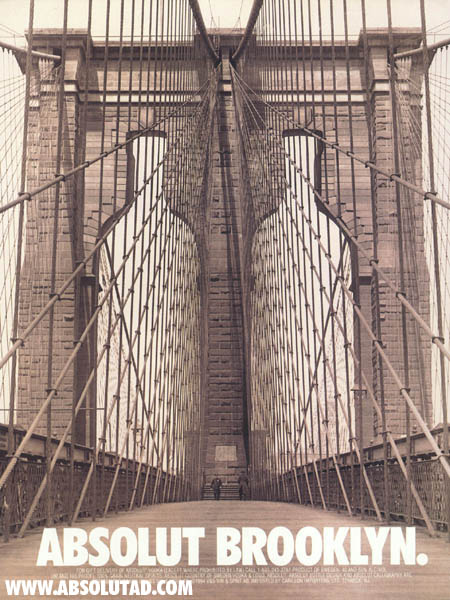
American culture is replete with images that hold strong meanings in the psyche of the public. Images of the World Trade Center on 9/11 bring up utter sadness, a portrait of George Washington utters America’s beginnings, and one of the Washington Monument shows the efficacy of American democratic government. Images like these can be used in different forms of media to relay their accordant emotions, having George Washington peddle cars for a 4th of July sale or pushing the war in Iraq with visible remembrance of the atrocity of 9/11. Another famous image that has been ingrained in American society is the Brooklyn Bridge, which Martin Filler, as quoted by Richard Haw, “has received ‘virtually unanimous critical acclaim.’” The Brooklyn Bridge stands for a multitude of things: Brooklyn and its advancement, America’s technological aptitude, and concurrent themes like freedom and democracy. As Haw says, it’s been used to hawk such items as “Royal Baking Powder, Lydia E. Pinkham’s Vegetable Compound, Williamantic Six-Cord Spool Cotton,” and more recently “Absolut Vodka.” The ad for Absolut calls upon sentiments of American solidarity, with Absolut being as important to society’s drinking as the Brooklyn Bridge is important to Brooklyn.
Saturday, November 24, 2007
Brooklyn Bridge
Haw writes of the Brooklyn Bridge, "...its cultural history owes as much to the imagination as it does to historical events." No where is this better expressed than in Whitman's unsought accreditation for the glorification of the Brooklyn Bridge. It is indeed peculiar that a poem which doesn't even speak of the bridge would somehow come to embody its importance in the world. But while it's peculiar, given the circumstances, it is not altogether misplaced.
As Haw's writing expresses, the Brooklyn Bridge had its fair share of media help on its path to becoming a main American attraction. Sometimes the reputation, mysteriousness, and sheer enormity of a thing can create for it a reputation that may not be an appropriate approximation of the things itself. But when it comes to Whitman's poem, Crossing Brooklyn Ferry, all the elements of creativity and mysticism associated with bridge were present in abundant detail. And the fact that the bridge itself is not mentioned physically doesn't appear to be a problem as it is more than adequately represented spiritually. The ferry and its surroundings represent the same sense of completeness and connection that the bridge does. The poem speaks of posterity, and the similarity of strangers as they all travel the same path. Whitman's poem brought out that which was best in the connection of Brooklyn to greater New York (whether it be via ferry or bridge), and that feeling of innovation and prosperity was inevitably endowed in the memory of the structure.
As Haw's writing expresses, the Brooklyn Bridge had its fair share of media help on its path to becoming a main American attraction. Sometimes the reputation, mysteriousness, and sheer enormity of a thing can create for it a reputation that may not be an appropriate approximation of the things itself. But when it comes to Whitman's poem, Crossing Brooklyn Ferry, all the elements of creativity and mysticism associated with bridge were present in abundant detail. And the fact that the bridge itself is not mentioned physically doesn't appear to be a problem as it is more than adequately represented spiritually. The ferry and its surroundings represent the same sense of completeness and connection that the bridge does. The poem speaks of posterity, and the similarity of strangers as they all travel the same path. Whitman's poem brought out that which was best in the connection of Brooklyn to greater New York (whether it be via ferry or bridge), and that feeling of innovation and prosperity was inevitably endowed in the memory of the structure.
Monday, November 19, 2007
I’ve spent more time in underground while living in New York City than I’ve ever been in my entire life. In fact the only time I’d ever been underground before this (aside from previous visits) was once when I was eleven I took a tour of a cave. When I was in the cave at one point the tour guide shut off the lights and it was the darkest experience I’ve ever had, the complete absence of light. Then she said that if person lived in a cave all their life and had babies in that cave and their children had babies in the cave the third generation would, through evolution, be born without eyes.
Living in New York City’s ‘pale’ underground could turn a man into a moth.
“Then he returns to the pale subways of cement he calls his home.”
The Man-Moth makes his home in the subway riding back and forth night after night and occasionally he emerges to the surface and ‘scales’ the outdoor tunnels of cement which don’t provide enough protection from the earth’s atmosphere for him.
“He thinks the moon is a small hole at the top of the sky, proving the sky quite useless for protection.”
In Manhattan you are inside even when you’re outside, without the lid. The concrete ground rises up around you high into the atmosphere. As you scale through the outdoor tunnels you look up to the sky beyond the buildings to see traces of the sun and the moon with almost no chance of stars. It doesn’t provide enough protection for a moth, but for a man it sounds almost like a cage. Living in the ‘World Capital’ as Jonathan Lethem puts it appears to me like putting ourselves into a cage similar to the cages we put the other animals on earth we consider ourselves superior to. If we make the deepest darkest part of that cage our home we may adapt like the Man-Moth, left only with our tears, our last piece of humanity; there is always water if you dig deep enough underground.
“Then from the lids one tear, his only possession--if you watch, he’ll hand it over, cool as from underground springs and pure enough to drink.”
Living in New York City’s ‘pale’ underground could turn a man into a moth.
“Then he returns to the pale subways of cement he calls his home.”
The Man-Moth makes his home in the subway riding back and forth night after night and occasionally he emerges to the surface and ‘scales’ the outdoor tunnels of cement which don’t provide enough protection from the earth’s atmosphere for him.
“He thinks the moon is a small hole at the top of the sky, proving the sky quite useless for protection.”
In Manhattan you are inside even when you’re outside, without the lid. The concrete ground rises up around you high into the atmosphere. As you scale through the outdoor tunnels you look up to the sky beyond the buildings to see traces of the sun and the moon with almost no chance of stars. It doesn’t provide enough protection for a moth, but for a man it sounds almost like a cage. Living in the ‘World Capital’ as Jonathan Lethem puts it appears to me like putting ourselves into a cage similar to the cages we put the other animals on earth we consider ourselves superior to. If we make the deepest darkest part of that cage our home we may adapt like the Man-Moth, left only with our tears, our last piece of humanity; there is always water if you dig deep enough underground.
“Then from the lids one tear, his only possession--if you watch, he’ll hand it over, cool as from underground springs and pure enough to drink.”
Subways
For Lethem the underground maze of subways is a place where the individual is put on display. He writes that although New Yorkers keep an appearance of indifference they are always inspecting their fellow passengers. Proper etiquette on the train is to never look anyone directly in the eyes and to feign interest in the television and community college ads. However everyone is always sizing up everyone else making sure there are no potential threats. To a tourist the subway may seem like chaos, but there is a routine and a set of unwritten rules. If anyone breaks this pattern, such as the "loopers", then they are immediately suspect to suspicion.
Sunday, November 18, 2007
#1
In "Speak, Hoyt Schermerhorn," Jonathan Lethem views the subway as a natural environment for the observation of people. Because it is such a an intimate surrounding, where people are literally on top of each other( especially in rush hour) the subway becomes an open and highly accepted forum to do embrace the act of studying, analyzing, and judging other people. Lethem says, " In truth, every subway rider is an undercover officer in a precinct house of mind, noticing and cataloguing outre and dissident behavior in his fellow passengers even while cultivating the apparent indifference for which New Yorkers are famous, above and below ground," to depict how even though people may put on the facade of not caring about their surroundings, they are constantly on the alert and break down "outre and dissident behavior". Furthermore, this practice of scrutinizing others is apparent in New Yorkers, "above and below ground," making the observation of others enmeshed in the culture. Lethem goes onto to say that, "we become spies, on the adults, the office workers, tourists, beggars, and policeman who'd share segments of our endless trip". Lethem takes on an alternate persona to try and feel a connection to the people in which he is in transit with. Him and his friend put on the persona as "spies" to get a deeper look into the lives of the individuals that "share segments of our endless trip." He even goes onto to view the personal affairs of the conductor, showing how the subway ride is more the just a mode of transportation, but is rather a mechanism for looking at people in their most vulnerable state: their unawareness.
Subway Underworlds
In Jonathan Lethem's memior, he described 'his' subway stop, Hoyt-Schermerhorn, as "...a functional ruin, an indifferent home to clockwork chaos, from the fact that it was, in objective measure, an anomalous place." To him, his subway stop is a place where he grew up, and watched it change throughout his life. Subway stops represent a space that ties peoples personal space such as their home, to the rest of the city- the subway stops are a transitional space. Along with the author, many people in the city are able to associate a subway stop with thier everyday life. They know the space by heart, and no matter how long they have been living in the city they have memories with the certain stop they use the most often. The subway stop is a transitional space in the sense that alothough it is a public space, many people who go to 'their' stop everyday start and end off their day at the stop. It is a gathering place for all different types of people, all with different agendas and memories and attachment to their stop.
The Inhuman Underground
In “The Man-Moth.” Elizabeth Bishop paints the subway as an inhuman space. In the first stanza, she speaks of Man, observing the “vast properties” of a female moon. There is a somewhat sexual and unquestionably human relationship between the Man and the moon.
The Man-Moth sees the moon in a different light. He is inhuman, a creature of the underground. His masculinity, his fearful longing for rebirth, and his tear all exhibit some inkling of humanness, but his subterranean dwelling is characterized as inherently inhuman. His home is a “pale [subway] of cement,” a place of “artificial tunnels” and the unnaturally abrupt start and stop of trains.
In contrast to the facades, bathed in moonlight, his home is inorganic; it is poisonous to the point that he must keep his hands in his pockets lest his glimmer of humanity seep from them, just as “others must wear mufflers” to keep the cold from stealing their human warmth.
But there is something of the subway that is human: the Man-Moth gives forth a tear from his black eye, his sole effect of humanity. He is selfish if “you’re not paying attention,” and will swallow it again, but if “you watch, he’ll hand it over.” The tear is not unnatural or poisonous, but “cool as from underground springs and pure enough to drink.” This tear is not like the strange moonlight or the hard cement, but liquid, and only attainable “if you catch him,” if someone is in the subway. Bishop seems to tell us that it is people that give the subway its human character.
The Man-Moth sees the moon in a different light. He is inhuman, a creature of the underground. His masculinity, his fearful longing for rebirth, and his tear all exhibit some inkling of humanness, but his subterranean dwelling is characterized as inherently inhuman. His home is a “pale [subway] of cement,” a place of “artificial tunnels” and the unnaturally abrupt start and stop of trains.
In contrast to the facades, bathed in moonlight, his home is inorganic; it is poisonous to the point that he must keep his hands in his pockets lest his glimmer of humanity seep from them, just as “others must wear mufflers” to keep the cold from stealing their human warmth.
But there is something of the subway that is human: the Man-Moth gives forth a tear from his black eye, his sole effect of humanity. He is selfish if “you’re not paying attention,” and will swallow it again, but if “you watch, he’ll hand it over.” The tear is not unnatural or poisonous, but “cool as from underground springs and pure enough to drink.” This tear is not like the strange moonlight or the hard cement, but liquid, and only attainable “if you catch him,” if someone is in the subway. Bishop seems to tell us that it is people that give the subway its human character.
The subway ride may be the longest time New Yorkers inhabit the same area at once. Of course there are few places in the city where one is not sharing space with others, but the subway is the only place where one is forced to stop moving and just be, along with everyone else. The pause provides an opportunity to make an impression. Normally New Yorkers are too focused on their own journey, traveling at their own pace. But on the subway, they are bound up with each other just long enough to notice other people. Jonathan Lethem describes a “right” of “invisibility” that every subway rider assumes he has. But the assumption stops in the subway, because eventually one will realize that he is being noticed as well. Below ground, one doesn’t try to be invisible so much as one tries not to stand out. The “irritation and panic [of the passengers] rises at each sign of oddness…” Lethem says. This oddness doesn’t need to be typically bizarre behavior; it doesn’t even need to be connected to insanity or danger. Oddness is just standing out.
11/19/07-#1
In Bishops's poem, "The Man-Moth" the tone of the writing is very delicate, yet forms deep ideas. I feel like this is such an accurate representation of a subway, or even just a subway station. There is safety deep in the tunnels, yet everything runs on a delicate consistency that can be wavered so easily. The cycle of trains moving in every direction can be confusing yet it is such a constant that hardly anyone forgets their trust in the train. When she writes, " He cannot tell the rate at which he travels backwards" I feel as though this line captures so much about what the subways are for everyone. They trust a silent cycle that could be quite confusing if one were to stay and try to navigate it themselves, but instead, "the pale subways of cement he calls his home." If you live in a city such as New York City, you can rely on the subways, though trains may change, there is still one that can always take you to exactly where you desire to be. Many could call it home in the way that it is always there, a supreme constant in an ever changing city.
#1
Bishops describes how th subway station is a break from the chaos of the city streets. On teh streets of the city there are so many people with so many places to be with so little time to do it. Combining all these people makes NYC sidewalks become comparable to a four lane high way. Someone who is not used to such traffic could easily compare NYC to chaos. The subways, however, are pretty calm. There is not much movement for one to accomplish on a subway. people get on and sit/stand still until they need to get off. Once your out the doors, though, you're right back int he chaos. On the subway itself it calming.
Still, no one smiles. Not that thats chaotic, but Bishop describes how he misses people smiling. In NYC, however, no one has the time to smile, or go out of there way to be nice.
NYC is described in stereotype (mostly truth) as a heartless place. If you get in the way, you very well may get trampled. But what you find when you live here, or spends a lot of time here, is that there is quite a realm of respect. True New Yorkers know that others have places to go. they know not to get in their way as long as they don't get in theirs. They are respectful in not bothering anyone else because we all have a place to go and don't have time deal with some idiot walking on the wrong side of the sidewalk, or stopping right in the goddamn middle to look at a really tall building. ITS A BUILDING!!!!! Its not that freakin special.
Still, no one smiles. Not that thats chaotic, but Bishop describes how he misses people smiling. In NYC, however, no one has the time to smile, or go out of there way to be nice.
NYC is described in stereotype (mostly truth) as a heartless place. If you get in the way, you very well may get trampled. But what you find when you live here, or spends a lot of time here, is that there is quite a realm of respect. True New Yorkers know that others have places to go. they know not to get in their way as long as they don't get in theirs. They are respectful in not bothering anyone else because we all have a place to go and don't have time deal with some idiot walking on the wrong side of the sidewalk, or stopping right in the goddamn middle to look at a really tall building. ITS A BUILDING!!!!! Its not that freakin special.
Speak, Hoyt-Schermerhorn
In Jonathan Lethem's autobiographical essay, "Speak, Hoyt-Schermerhorn," the subway and the station represent a multitude of things simultaneously. As a child growing up, the station "Was the most famous subway station in the world" (73) to Lethem because it was his local one. In the historical context of the neighborhood, Lethem describes the station as giving "Testimony to the lost commercial greatness of the area" (73) due to the station's reflection of the decline in the world above. In his time growing up Lethem states how the station was "Synonymous with crime" (73). For Lethem, the subway has always been a personal place to "Colonize [his] dreams" (74), in terms of both his imagination and the ceaseless bounds the subway took to create eerie realities for him. Lethem describes the origins of the subway as reflecting "A bastard convergence of utopian longing and squalid practicality" (75). Growing up, the A train "Out of Hoyt-Schermerhorn was now [his] twice daily passage" (75) that represented the journey to and from school. The station is also symbolic for Lethem of how he "Slid briefly across the separation line" (78) between identifying with the "harsher truths of the street" (78), and carrying "His parents' sensitivities and standards, with him" (78). The station encapsulates the struggle of these conflicting identities as a result of where he happens to live. The subway and the station are not one thing to him, but many.
Topic # 1
The subway allows one to judge other5 New Yorkers, Lethmen writes
"In truth, every subway rider is an undercover officer in a precint house of mind, noticing and cataloguing outre and dissident behavior in his fellow passengers even while cultivating the apparent indifference for which New Yorkers are famous, above and below ground." But Lethmen also writes that New Yorkers cultivate their indifference in the subway, this shows that they bring their same sentiments underground as they do above. Lethmen also notes that subways are often spots for criminal activity, he lists ways to avoid trouble by looping and exiting the train at the last moment. along thew same lines as everyone being an undercover officer in the subway he notes that as a child him and his friends would come "spies, on the adults, the office wotrkers, tourists, beggars, and policemen who'd share segments of [their] endless trip." There is also an immense amount of history at every stop as Lethmen lets us know about the Hoyt street stop in Brooklyn, such things as "ghost platforms." Fpr example if you take the 6 local to Brooklyn Bridge City Hall and don't get off when you are prompted to you will end up in the old city hall station which is grand but abandoned, a "ghost station," before you change tracks to go back uptown.
"In truth, every subway rider is an undercover officer in a precint house of mind, noticing and cataloguing outre and dissident behavior in his fellow passengers even while cultivating the apparent indifference for which New Yorkers are famous, above and below ground." But Lethmen also writes that New Yorkers cultivate their indifference in the subway, this shows that they bring their same sentiments underground as they do above. Lethmen also notes that subways are often spots for criminal activity, he lists ways to avoid trouble by looping and exiting the train at the last moment. along thew same lines as everyone being an undercover officer in the subway he notes that as a child him and his friends would come "spies, on the adults, the office wotrkers, tourists, beggars, and policemen who'd share segments of [their] endless trip." There is also an immense amount of history at every stop as Lethmen lets us know about the Hoyt street stop in Brooklyn, such things as "ghost platforms." Fpr example if you take the 6 local to Brooklyn Bridge City Hall and don't get off when you are prompted to you will end up in the old city hall station which is grand but abandoned, a "ghost station," before you change tracks to go back uptown.
Kamala's Post
Kamala Randjelovic
Posting for Monday, November 19th, 2007
Question # 1
In Jonathan Lethem’s memoir “Speak, Hoyt Schmerhorn” he elegantly and evocatively describes the merging of the public and personal space within subway stations. A major point of his piece is how the subway “…station itself gave testimony to the lost commercial greatness of the area” (73). I related strongly to Lethem’s observations about the neighborhood, the station and the trains themselves both from the practical level as a lifelong subway rider, and for sentimental reasons. As a child and teenager, I constantly walked through the Hoyt Schemerhorn station –either on route to the apartment of my best friend, Devon (who lived two blocks from the station) or returning to the city. Whichever direction we were headed, we would take the F train at 2nd Avenue and catch the A at Jay Street Borough Hall and get off at Hoyt. In the act of riding the subway, Lethem identifies subway riders as
…an undercover officer in a precinct state of mind, noting and cataloguing outré and dissident behavior in his fellow passengers even while cultivating the apparent indifference for which New Yorkers are famous. (74)
When Devon and I rode the subway, we too became those undercover officers. We carefully noted our fellow riders starting with those who stood close to us on the platform. As children, Devon and I lived in un-gentrified neighborhoods and we were therefore studiedly careful but not overtly cautious. We learned early that subway stations and trains allow riders to physically be surrounded by strangers yet stay in their own bubble. Our fellow riders maintained their own habits in that underworld despite the crush of the crowd.
For most subway riders, the system itself is detrimental in enabling people to get where they are going. Subway riders establish rituals “(despite an appearance of chaos the system is regular” (75). Like city streets where crowds engulf the sidewalk, stations are overflowed with people, yet because of the smaller space and even danger of the tracks, there is also distance. Even when stations are crammed with people, there is still decorum. Most people do not shove and push on subway platforms (like on the streets). Lethem describes how he and his companion “…became spies on the adults, the office worker, tourists, beggars, and policemen who’d share segments of our endless trip” (75). Those who consistently use the subways live with a sense of expectancy - wondering who will be encountered on the subway platform - at what time, and where.
In other worlds, the subway simply transports individuals into their ritualized life, depositing them at a specific destination. In the subways, there is always a sense of unknown, the idea of encountering the unexpected. My mother has never forgotten one Christmas twenty two years ago, the sight of a man with a Christmas tree on the L line going to Williamsburg. Lethem calls subway stations “…a sinkhole of destroyed and thwarted time” (79). For me, subways are spaces which redefine the entire concept of time i.e. delays can be unexpected and sporadic or dramatic and pronounced –adding a whole level of drama to the routine of commuting from one place to another.
Posting for Monday, November 19th, 2007
Question # 1
In Jonathan Lethem’s memoir “Speak, Hoyt Schmerhorn” he elegantly and evocatively describes the merging of the public and personal space within subway stations. A major point of his piece is how the subway “…station itself gave testimony to the lost commercial greatness of the area” (73). I related strongly to Lethem’s observations about the neighborhood, the station and the trains themselves both from the practical level as a lifelong subway rider, and for sentimental reasons. As a child and teenager, I constantly walked through the Hoyt Schemerhorn station –either on route to the apartment of my best friend, Devon (who lived two blocks from the station) or returning to the city. Whichever direction we were headed, we would take the F train at 2nd Avenue and catch the A at Jay Street Borough Hall and get off at Hoyt. In the act of riding the subway, Lethem identifies subway riders as
…an undercover officer in a precinct state of mind, noting and cataloguing outré and dissident behavior in his fellow passengers even while cultivating the apparent indifference for which New Yorkers are famous. (74)
When Devon and I rode the subway, we too became those undercover officers. We carefully noted our fellow riders starting with those who stood close to us on the platform. As children, Devon and I lived in un-gentrified neighborhoods and we were therefore studiedly careful but not overtly cautious. We learned early that subway stations and trains allow riders to physically be surrounded by strangers yet stay in their own bubble. Our fellow riders maintained their own habits in that underworld despite the crush of the crowd.
For most subway riders, the system itself is detrimental in enabling people to get where they are going. Subway riders establish rituals “(despite an appearance of chaos the system is regular” (75). Like city streets where crowds engulf the sidewalk, stations are overflowed with people, yet because of the smaller space and even danger of the tracks, there is also distance. Even when stations are crammed with people, there is still decorum. Most people do not shove and push on subway platforms (like on the streets). Lethem describes how he and his companion “…became spies on the adults, the office worker, tourists, beggars, and policemen who’d share segments of our endless trip” (75). Those who consistently use the subways live with a sense of expectancy - wondering who will be encountered on the subway platform - at what time, and where.
In other worlds, the subway simply transports individuals into their ritualized life, depositing them at a specific destination. In the subways, there is always a sense of unknown, the idea of encountering the unexpected. My mother has never forgotten one Christmas twenty two years ago, the sight of a man with a Christmas tree on the L line going to Williamsburg. Lethem calls subway stations “…a sinkhole of destroyed and thwarted time” (79). For me, subways are spaces which redefine the entire concept of time i.e. delays can be unexpected and sporadic or dramatic and pronounced –adding a whole level of drama to the routine of commuting from one place to another.
Subway Underworlds: 1
The subways of New York City display it’s rich past, now mired by constant changes and transformations to its analogous landscape. The streets of New York City are riddled with old, new spaces: buildings built right atop the remains of past buildings, streets with old and new trash stamped forever into the cement, and public parks that also serve as mass burial grounds to old citizens of New York who died in bouts with rampant disease. The subways of New York, as documented by Jonathan Lethem in Speak Hoyt-Schermerhorn, share the same forgotten history:
The Hoyt-Shermerhorn station stood at the border of the vibrant mercantile disarray of Fulton Street—once the borough’s poshest shopping and theater boulevard. […] The station itself gave testimony to the lost commercial greatness of the area. (73)Lethem looks past the run-down station of the present, taking in its rich history accompanied by its inglorious fall to crime. The Hoyt-Schermerhorn station, although run down now, will forever hold its status of grandeur through memory. As long as people like Lethem are still alive, nothing will be able to “displace [the] memory’s primacy or fade its color” (79).
Saturday, November 17, 2007
Thoughts From a Subway to Queens
I figured the most authentic way to complete this week's reading was to dive into the words of Bishop and Lethem while taking the F train to Queens. It wasn't my intention to get lost in the reading and consequently end up in unknown territory but next thing I knew I was the unfortunate recipient of a native New Yorker's pity filled head shake as I asked how far we were from Steinway Street. And it was when I finally emerged (an hour and a half later) into the West 4th St. station, back home, that I fully appreciated Lethem's words.
He described the infinate comfort which accompanies the feeling of familiarity. For Lethem, the Hoyt-Schermerhorn station was a strange embodiment of all the good, bad, and just plain outragreous qualities that made New York his home. And it's curious how such a space that goes against every natural human instinct associated with comfort could be so powerful. For as Bishop related in her poem, Moth-Man, there is something unnatural and stifling in the world underground.
But for me it seems that the subway system stands as an important symbol of solidarity for each and every city dweller. Once down in a station or on a train we are all equally as vulnerable to the actions of the next. And that sort of vulnerability can be liberating and frightening. For Lethem (and I've come to realize for me too) a familiar station can represent a place of security, a point in which it's possible to assert some sort of identity, an identity that's so important when in contrast to the immensity of the subway system and New York itself.
He described the infinate comfort which accompanies the feeling of familiarity. For Lethem, the Hoyt-Schermerhorn station was a strange embodiment of all the good, bad, and just plain outragreous qualities that made New York his home. And it's curious how such a space that goes against every natural human instinct associated with comfort could be so powerful. For as Bishop related in her poem, Moth-Man, there is something unnatural and stifling in the world underground.
But for me it seems that the subway system stands as an important symbol of solidarity for each and every city dweller. Once down in a station or on a train we are all equally as vulnerable to the actions of the next. And that sort of vulnerability can be liberating and frightening. For Lethem (and I've come to realize for me too) a familiar station can represent a place of security, a point in which it's possible to assert some sort of identity, an identity that's so important when in contrast to the immensity of the subway system and New York itself.
1.
Lethem's essay reveals the ways in which his childhood, past experiences, and imagination shaped this station to be a kind of monolithic fantasy. He first begins by explaining its importance, and illustrating how that importance came about through a series of personal stories. As the essay progresses, the reader sees how, more than anything, Hoyt-Schermerhorn has become a place where his imagination has run rampant; as we see in his detailed imitation of the "Wisconsin Death Trip," this train station is the living novella of his daydreams, barely grounded by the historical and mundane context of the actual structure.
Bishop's poem is much more abstract, with a meaning that could be taken in many different ways. However, in the context of the subway system, Bishop seems to focus on the new relationship that man has with the sky after being underground for so long. She questions which is the real home of the Man-Moth, above or below ground? The underground is an escape for the Man-Moth, a prison, but also a symbol of his own choice, and what that says about him.
Comparatively, the subway is an even stranger urban space than a streetwise neighborhood or business district because it almost defies nature. As Bishop delicately suggests, underground habitation may be unnatural, a theory that Lethem almost echos in his fantastical imaginings of the subway. But if so, what does this say about the progression of civilization and urbanization? Are we willing to subvert nature in order to keep expanding? And when we begin to prefer this, perhaps false, underground parody of above ground, what does this mean?
Bishop's poem is much more abstract, with a meaning that could be taken in many different ways. However, in the context of the subway system, Bishop seems to focus on the new relationship that man has with the sky after being underground for so long. She questions which is the real home of the Man-Moth, above or below ground? The underground is an escape for the Man-Moth, a prison, but also a symbol of his own choice, and what that says about him.
Comparatively, the subway is an even stranger urban space than a streetwise neighborhood or business district because it almost defies nature. As Bishop delicately suggests, underground habitation may be unnatural, a theory that Lethem almost echos in his fantastical imaginings of the subway. But if so, what does this say about the progression of civilization and urbanization? Are we willing to subvert nature in order to keep expanding? And when we begin to prefer this, perhaps false, underground parody of above ground, what does this mean?
Monday, November 12, 2007
Question 2
It's a stretch, to relate this woman's encounter to a terrorist attack. I would never have otherwise connected the two. But now that I think about it, it's clearly understood; the helplessness, the confusion, the discomfort and remorse. It's fear.
Delillo describes how these paintings can give a person a sense of disparity and uncertainty. I and many others felt the same on 9-11. I can tell you exactly where I was, exactly what I was wearing, and exactly what visage swept across the faces of my classmates and teachers as the news was broadcasted over the school intercom. People were scared, people were uncertain, people were helpless. I remember how dreary the school day proceeded. I remember how shocked the world was around me. All day and the many weeks to fallow they showed and replayed the footage of the plane soaring into the towers. You could see the people on the top floors, how scared they were, throwing themselves out of the windows praying something might catch them, that they might not have to die. Imagine the regret they felt for getting up at all that day. for going through their monotonous routine of kissing the wife or husband good-bye and commuting to a regular work day.
Seconds after the incident, hospitals all around prepared for chaos...but no one came. No one needed to be saved. The sad and depressing story of no casualties, but only death. And if you weren't dead then you weren't close enough to need help at all.
I went down to the water front after class and stared at the New York City skyline, but it wasn't there. There was no skyline, just smoke; black, thick smoke. It was gone.
Do you sense my remorse of the hundreds of lives that I didn't know, or otherwise care about, that were taken? Do you sense my anger? Do you sense the despair and uncertainty of all those who watched it happen but could do nothing to save these people who have no other choice but to leap from 50 stories up? Do you remember? Watching bodies fly from the building as it fell? Do you sense it?
Paintings may give you a small spec of emotion that makes you feel uncomfortable, you may even feel a little remorse, but living it, being there, watching the gore and being able to do nothing to help these lives makes you "feel" more than any painting can. 9-11 was hard. 9-11 was devastating. 9-11 will never be forgot by those who lived it. Those people are, only after the fact, my siblings. Those people now hold a place in my heart, and they will live on in our spirits until we die off, and only textbooks can try to describe the history of where once stood the Twin Towers.
Delillo describes how these paintings can give a person a sense of disparity and uncertainty. I and many others felt the same on 9-11. I can tell you exactly where I was, exactly what I was wearing, and exactly what visage swept across the faces of my classmates and teachers as the news was broadcasted over the school intercom. People were scared, people were uncertain, people were helpless. I remember how dreary the school day proceeded. I remember how shocked the world was around me. All day and the many weeks to fallow they showed and replayed the footage of the plane soaring into the towers. You could see the people on the top floors, how scared they were, throwing themselves out of the windows praying something might catch them, that they might not have to die. Imagine the regret they felt for getting up at all that day. for going through their monotonous routine of kissing the wife or husband good-bye and commuting to a regular work day.
Seconds after the incident, hospitals all around prepared for chaos...but no one came. No one needed to be saved. The sad and depressing story of no casualties, but only death. And if you weren't dead then you weren't close enough to need help at all.
I went down to the water front after class and stared at the New York City skyline, but it wasn't there. There was no skyline, just smoke; black, thick smoke. It was gone.
Do you sense my remorse of the hundreds of lives that I didn't know, or otherwise care about, that were taken? Do you sense my anger? Do you sense the despair and uncertainty of all those who watched it happen but could do nothing to save these people who have no other choice but to leap from 50 stories up? Do you remember? Watching bodies fly from the building as it fell? Do you sense it?
Paintings may give you a small spec of emotion that makes you feel uncomfortable, you may even feel a little remorse, but living it, being there, watching the gore and being able to do nothing to help these lives makes you "feel" more than any painting can. 9-11 was hard. 9-11 was devastating. 9-11 will never be forgot by those who lived it. Those people are, only after the fact, my siblings. Those people now hold a place in my heart, and they will live on in our spirits until we die off, and only textbooks can try to describe the history of where once stood the Twin Towers.
Don Delillo
"IT wasn't like her to use this term - "the state" - in the ironclad context of supreme public power. This was not her vocabulary." How many times have we all heard such similar sentiments dressed in the concerns of a different conflict? The way we speak so unfalteringly of "the Bush administration" or "terrorists" as if we had some knowledge beyond that of the 5 o'clock news and the ignorant opinions of great uncles and the like.
But Delillo's essay allows us to explore the tricky game of political memory in a more poetic fashion. In the context of 911, the essay shows how it's easy to become swayed by a person (the museum man)or a cause when there is strong emotion attached to the situation. For example, the man in Delillo's essay says, "See how easy. NOw you. Start with the shoes, first one, then the other." This may be a stretch but I interpret this line to be synonymous with how a people can become intoxicated with unreasonable ideas about a place or people. It's easy for it to happen. You just (as the man said), start with one misinterpretation and then step follows step until one's trapped in a bathroom of misinformation.
But Delillo's essay allows us to explore the tricky game of political memory in a more poetic fashion. In the context of 911, the essay shows how it's easy to become swayed by a person (the museum man)or a cause when there is strong emotion attached to the situation. For example, the man in Delillo's essay says, "See how easy. NOw you. Start with the shoes, first one, then the other." This may be a stretch but I interpret this line to be synonymous with how a people can become intoxicated with unreasonable ideas about a place or people. It's easy for it to happen. You just (as the man said), start with one misinterpretation and then step follows step until one's trapped in a bathroom of misinformation.
Sunday, November 11, 2007
#2
The entire relationship that the women feels with the paintings could be described as the same emotional connection that people felt with the media images after 9/11. At first the women feels "helpless" when viewing the paintings, often how much of the US felt when viewing respectively the image of the planes crashing into the two towers. Nonetheless of the women's feelings of discomfort, she visited day after day, for 3 days to view the same paintings. She says " At first I was confused, and still am, a little. But, I know I love the paintings now." This shows a parallel between how the individual viewer became so bombarded by the same broadcast, whether it was FOX or CNN, they were "confused". But, after sitting and watching around the clock, the people began to accept what was being shown to them, without question or internalization, the United States manipulated it's civilians with fear. By making them feel safe, they began to ""love" the idea that these images represented the idea that our democracy, our country and everything that we stand for was in jeopardy, which is why without question we submitted ourselves to war. In retrospect, the man offers a different view on the paintings, the little voice that most of the US silenced when our irrationalities and fear got the best of us. "Everybody dead" is what the man responds to, the reality that our country chose to ignore.
Delillo offers an interesting commentary on the effects of terrorism in his short story “Baeder-Meinhof.” After the terrifying event involving the man from the museum, the narrator describes “everything in the room [as having] a double effect – what it was and the association it carried in her mind." After the man is gone, she is unable to mentally disconnect the things in her apartment from the petrifying encounter.
Delillo is pointing to the effects of a terrifying event like that in the story (or possibly a terrorist attack as is alluded to by the exhibit and the title) on the psyche, especially with relation to memory. The comon thread of this event and an act of terror is a fear for one’s life. Long after such an event occurs, we are reminded of it by images relating to it. Every time we recall this instance we realize that something similar could happen again and fear for our lives. We are frequently reminded by connections made in that moment relating to things we frequently see or think about and consequently live in a state of constant fear.
And so, the implications of such an event are tremendous. In a society where every single individual has seen the image of a terrorist attack that killed thousands of his fellow innocent citizens, every individual develops these types of connections and as a consequence the entire society exists in a state of fear. No American can possibly think of September 11, the Twin Towers, NYFD, or even New York City without remembering and feeling the fear they felt for their own lives when they saw the towers collapse.
Delillo is pointing to the effects of a terrifying event like that in the story (or possibly a terrorist attack as is alluded to by the exhibit and the title) on the psyche, especially with relation to memory. The comon thread of this event and an act of terror is a fear for one’s life. Long after such an event occurs, we are reminded of it by images relating to it. Every time we recall this instance we realize that something similar could happen again and fear for our lives. We are frequently reminded by connections made in that moment relating to things we frequently see or think about and consequently live in a state of constant fear.
And so, the implications of such an event are tremendous. In a society where every single individual has seen the image of a terrorist attack that killed thousands of his fellow innocent citizens, every individual develops these types of connections and as a consequence the entire society exists in a state of fear. No American can possibly think of September 11, the Twin Towers, NYFD, or even New York City without remembering and feeling the fear they felt for their own lives when they saw the towers collapse.
Post-9/11 Literature
I feel like this story relates to the terrorist attacks on 9/11 by discussing the effects of people's everyday lives through activities and interactions other than directly seeing the attacks or having lost a loved one. The paintings in the museum were about terrorists from a different place and time period, but they brought together all sorts of oridinary people who all have in common the fact that they are living in a post-terrorist city. The interaction at the museum between the man and the woman displayed the aftermath of the attacks on everyone's personal lives. The two were brought together through the paintings, but felt a strange connection through their recent loss of a job, and a strange feeling of loneliness. The woman described the paintings as having a sense of hopelessness, and this was also relfected towards the characters. Both felt somewhat obligated to act a certain way towards eachother with no real sense of direction, and blindly interacting due to thier own feelings of hopelessness and uncerainty of how to go on with thier lives in this post-9/11 world. Both of te characters were trying to fill a void which was taken away from them after the attacks- whether it be thier jobs or people they knew. The paintings were sort of a realization that the world does go on after horrible things, but the memory of it will always exist, it is just a matter of coping with it and finding your place in a world of fear and turnmoil.
Post-9/11 Literature: Number 2
"I don't know what happened," she said. "I'm only telling you what people believe. It was 25 years ago. I don't know what it was like then, in Germany, with bombings and kidnappings."
I’d never heard of Baader-Meinhof before reading this story. Looking back, I can clearly remember times when I’ve crossed paths with a cultural reference towards it: during the movie Munich, a brief mention towards the end of World History class, a shirt with the iconic symbol. I’m almost mad at myself for not being informed; I tend to picture myself as someone who is up to date on current (and past events), and not knowing about Baader-Meinhof kind of soils my reputation I’ve given to myself.
I feel like my ignorance tells a lot about the post-9/11 mind set, an idea broached in Don DeLillo’s short story, “Baader-Meinhof.” The Red Army Faction–along with the trials of its members–became a main fixture in German culture for decades. There were riots, murders, and vigils from all sides of the conflict. All of this stemmed from terrorism, now a main fixture of American society when it flew over the ocean and in to two buildings in New York city. The difference between Baader-Meinhof in Germany and 9/11 in America has to do with the reaction of the American public. Most of the public, including the female character in DeLillo’s story, wouldn’t think to compare what happened in Germany during the 60's and 70's to the recent act of terrorism in 2001. Like the woman in “Baader-Meinhof”–who says “I don’t know what it was like then, in Germany, with bombings and kidnappings”–many Americans tend to see the terrorism that took place during 9/11 as a phenomenon in man’s history. 9/11 was an atrocity, considered to be the worst act of terrorism in American history, but man has been killing man for centuries. The American public needs to look to the past–only having to search as close as 1976–to find terrorism’s roots.
I’d never heard of Baader-Meinhof before reading this story. Looking back, I can clearly remember times when I’ve crossed paths with a cultural reference towards it: during the movie Munich, a brief mention towards the end of World History class, a shirt with the iconic symbol. I’m almost mad at myself for not being informed; I tend to picture myself as someone who is up to date on current (and past events), and not knowing about Baader-Meinhof kind of soils my reputation I’ve given to myself.
I feel like my ignorance tells a lot about the post-9/11 mind set, an idea broached in Don DeLillo’s short story, “Baader-Meinhof.” The Red Army Faction–along with the trials of its members–became a main fixture in German culture for decades. There were riots, murders, and vigils from all sides of the conflict. All of this stemmed from terrorism, now a main fixture of American society when it flew over the ocean and in to two buildings in New York city. The difference between Baader-Meinhof in Germany and 9/11 in America has to do with the reaction of the American public. Most of the public, including the female character in DeLillo’s story, wouldn’t think to compare what happened in Germany during the 60's and 70's to the recent act of terrorism in 2001. Like the woman in “Baader-Meinhof”–who says “I don’t know what it was like then, in Germany, with bombings and kidnappings”–many Americans tend to see the terrorism that took place during 9/11 as a phenomenon in man’s history. 9/11 was an atrocity, considered to be the worst act of terrorism in American history, but man has been killing man for centuries. The American public needs to look to the past–only having to search as close as 1976–to find terrorism’s roots.
The thing that reverberates through people after an act terrorism is lack of trust resulting in an inability to connect with each other. The alienation this provokes leaves people in a desperate position to make a connection. The two strangers meet and he goes to the girls apartment they’re reaching out for a connection.
“Lets be friends, lets just be friends.” He becomes slightly aggressive in his advancements and even though her initial instinct is not to bring him to her apartment in the first place, she does because of curiosity and longing. This is how I think people have been affected on a larger scale after 9/11 and a representation of a parallel between this story and that event; paranoia, distrust, alienation, desperation and longing for trust and a connection with humanity that has been lost.
“Lets be friends, lets just be friends.” He becomes slightly aggressive in his advancements and even though her initial instinct is not to bring him to her apartment in the first place, she does because of curiosity and longing. This is how I think people have been affected on a larger scale after 9/11 and a representation of a parallel between this story and that event; paranoia, distrust, alienation, desperation and longing for trust and a connection with humanity that has been lost.
Post for 11-12-07
Kamala Randjelovic
Posting for November 12th, 2007
Question # 2
The story “Baeder-Meinhof” by Don Delillo trails two individuals observing paintings of a terrorist group (“Rote Armee Faktion”) who exercised guerilla warfare in the nineteen seventies in Germany. In a post 9-11 world, particularly in New York City the threat and most importantly the memory of the attacks and of the fear it instilled in the inhabitants of the city and world remains present. In a way, the perceptions of the paintings of these two people can reflect an attitude that many have regarding the threat of terrorism. When viewing a painting the woman remarks about “…the state- in the ironclad context of supreme public power” stating “This was not her vocabulary”. From this statement one can see the disconnect many experience in the relationship between the “state” and individual”. As she says “there’s so much sadness in these pictures” and “…I feel helpless. These paintings make me feel how helpless a person can be”, the paintings seem to awaken feelings induced by the present day threat of terrorism. On the day of 9-11 there was a strong sense of loneliness and disparity throughout the city. I remember the day like it was yesterday, I will never forget walking through the east village which was completely empty and void of the regular crowds inhabiting the streets. That emptiness of people remained for days after the attacks, the city streets felt deserted and it seemed that people had resorted to their own worlds. In the story, when “…she didn’t tell him that she was out of work, because it would give them a situation in common. She didn’t want that, an inflection of mutual sympathy, a comradeship”, it occurred to me that in viewing these pieces of art in some ways they were both distancing themselves from the outside world. The outside world, where the threat of terrorism is constantly projected from politicians, and the media. When one looks at a piece of art, there is always an absence of comradeship in the perception of art since everyone has their own interpretations of what is being represented and its meaning. When it comes to acts of terrorism and living in a world after all sorts of terrorist attacks, very rarely are people allowed to make their own meaning of the events. In many ways, society seems to project images and information geared at influencing how people think about terrorism and who and what a terrorist is. An individual can either experience an immense sense of loneliness with their own internal struggle to find what they believe is threatening. Or they can experience a strong sense of community and patriotism by joining with the beliefs of the majority in the external world. This story seems to be representative of two individuals who are each trying to make sense of the world around them by not merging with each other and those around them. By observing the art and struggling to find its meaning, their own feelings are awakened and they choose to sit with those feelings instead of joining with each other.
Posting for November 12th, 2007
Question # 2
The story “Baeder-Meinhof” by Don Delillo trails two individuals observing paintings of a terrorist group (“Rote Armee Faktion”) who exercised guerilla warfare in the nineteen seventies in Germany. In a post 9-11 world, particularly in New York City the threat and most importantly the memory of the attacks and of the fear it instilled in the inhabitants of the city and world remains present. In a way, the perceptions of the paintings of these two people can reflect an attitude that many have regarding the threat of terrorism. When viewing a painting the woman remarks about “…the state- in the ironclad context of supreme public power” stating “This was not her vocabulary”. From this statement one can see the disconnect many experience in the relationship between the “state” and individual”. As she says “there’s so much sadness in these pictures” and “…I feel helpless. These paintings make me feel how helpless a person can be”, the paintings seem to awaken feelings induced by the present day threat of terrorism. On the day of 9-11 there was a strong sense of loneliness and disparity throughout the city. I remember the day like it was yesterday, I will never forget walking through the east village which was completely empty and void of the regular crowds inhabiting the streets. That emptiness of people remained for days after the attacks, the city streets felt deserted and it seemed that people had resorted to their own worlds. In the story, when “…she didn’t tell him that she was out of work, because it would give them a situation in common. She didn’t want that, an inflection of mutual sympathy, a comradeship”, it occurred to me that in viewing these pieces of art in some ways they were both distancing themselves from the outside world. The outside world, where the threat of terrorism is constantly projected from politicians, and the media. When one looks at a piece of art, there is always an absence of comradeship in the perception of art since everyone has their own interpretations of what is being represented and its meaning. When it comes to acts of terrorism and living in a world after all sorts of terrorist attacks, very rarely are people allowed to make their own meaning of the events. In many ways, society seems to project images and information geared at influencing how people think about terrorism and who and what a terrorist is. An individual can either experience an immense sense of loneliness with their own internal struggle to find what they believe is threatening. Or they can experience a strong sense of community and patriotism by joining with the beliefs of the majority in the external world. This story seems to be representative of two individuals who are each trying to make sense of the world around them by not merging with each other and those around them. By observing the art and struggling to find its meaning, their own feelings are awakened and they choose to sit with those feelings instead of joining with each other.
2.
I was deeply struck by the perspective Don DeLillo revealed in "Baader-Meinhof," and the complexity of this very delicate subject. It was so strange and sad, because this woman struggles, like many of us, to understand the events which took place, now viewed through the lens of this artist. On one hand, she knows that these people commited attrocities, but on the other hand she feels a fascination towards them, almost a curious compassion.
Connecting this story to post-9/11 New York is in some ways difficult, because the factors which connect the two events are broad, such as terrorism, interpersonal relationships, and one's approach to strangers.
What seemed the most relevant to me was the exchange with this man. After sharing such a complicated experience in the gallery, their conversations afterwards take on a whole other light. In the back of our mind, aren't we, as readers, filled with hesitation as she invites him into her home? It seems that in a world where these acts of terrorism can happen, suspicion and an element of fear color every day life. In the scene in the bedroom, she debates over whether or not to lock the bathroom door, how to make him leave without provoking him, fearing rape. However, in the same way that the paintings present two different sides of these terrorists, and of terrorism, in the same way that there is a murderer dying, but also a young girl who has not yet become this older, hardened version of herself; in that same way that there is a cross, or perhaps just stray brushstrokes, this woman feels an affinity to this man, an instinctive pull. There is fear, fear of being misused for one's trust, but also loneliness, humanity, and compassion for someone who has the potential to do you harm.
Connecting this story to post-9/11 New York is in some ways difficult, because the factors which connect the two events are broad, such as terrorism, interpersonal relationships, and one's approach to strangers.
What seemed the most relevant to me was the exchange with this man. After sharing such a complicated experience in the gallery, their conversations afterwards take on a whole other light. In the back of our mind, aren't we, as readers, filled with hesitation as she invites him into her home? It seems that in a world where these acts of terrorism can happen, suspicion and an element of fear color every day life. In the scene in the bedroom, she debates over whether or not to lock the bathroom door, how to make him leave without provoking him, fearing rape. However, in the same way that the paintings present two different sides of these terrorists, and of terrorism, in the same way that there is a murderer dying, but also a young girl who has not yet become this older, hardened version of herself; in that same way that there is a cross, or perhaps just stray brushstrokes, this woman feels an affinity to this man, an instinctive pull. There is fear, fear of being misused for one's trust, but also loneliness, humanity, and compassion for someone who has the potential to do you harm.
Baader-Meinhof #2
Don DeLillo's story, "Baader-Meinhof," shows us how terrorism in the past can impact both culture, in this case through Gerhard Richter's paintings, and the future generations to come after the actual incident. The story teaches us that the images of terrorism will always be remembered and have an effect on the people who view them, which is the premise for the interaction in the story between the man and the woman in the museum. DeLillo may be trying to show us that the man acts the way he does because he looked at Richter's RAF paintings, but ultimately it is ambiguous to determine and arguments can be made either way. Regardless, DeLillo is saying that 9/11 is capable of impacting people in the same way as the RAF attacks and Richter's paintings, however that may be.
The first impression of Gerhardt Richter’s cycle of paintings, October 18, 1977, is one of darkness and confusion. The series of paintings are based on real images; they are black-and-white, smudged distortions, as though they have been left in the rain. “So shadowy. No color,” is how one of the characters in Don DeLillo’s story, Baader-Meinhof, describes the paintings. But clarity and lightness in the images would oppose the subject of the paintings: the arrest and deaths of the leaders of the Rote Armee Faktion, a 1970s West German terrorist group. Urban guerillas? Revolutionaries? Terrorists? The uncertainty of how to classify the young, dead radicals in the paintings pervades the mind of viewer and is reflected in DeLillo’s story. The characters are never named, hardly described, and their objectives are hard to identify. There is a woman and a man. There meet in a museum, viewing Richter’s October 18, 1977. They are both alone, perhaps lonely? The woman seems to connect with the paintings, or she desires to connect with them. It’s her third day viewing them and the subjects are familiar to her; she comes to know them intimately through the portraits of their death. “At first I was confused,” she says, “[I] still am, a little. But I know I love the paintings now.” The man is at the museum to pass the time; at least that’s what he claims. He is interested in the woman as she is in the paintings. They both want to know and understand subjects that will not let them pass certain boundaries. No matter how much the woman studies the paintings, there will always be spots that she can’t figure out—is it a tree or a cross? She will still wonder, how did they die? Baader, Ulrike, and Gudrun? Even if the man can engage a conversation with the woman; he can even accompany her home and proposition her. She will still lock a bathroom door between them, and show him that his curiosity is inappropriate, too much, too fast. But the man and woman cannot break their desire; the need to understand is almost addicting, and it draws them back. They return to the museum, to the haunting obscurity of the paintings. But did they return only for the art, or did they find another object that they must figure out? Despite the bleakness and the distortion, one continues to study Richter’s images because they hold a promise of something deeper. DeLillo’s story shows how the same dynamic can be found between people.
Saturday, November 10, 2007
Response to # 2
For me the most poignant part of Delillo's Baader-Meinhof was the aftermath of the peculiar goings on in the protagonists apartment, how "She saw everything twice." Undoubtedly every New Yorker who was in the city for the 9/11 attacks sees everything twice perhaps not as much now, but certainly very clearly for the years immediately ensuing. Delillo writes "Nearly everything in the room had a double effect-what it was and the association it carried in her mind..." she often curses the man "Bastard" or in a New Yorkers mind "Bastards." I'm not sure if one can majke a direct comparison between the trauma of 9/11 and a stranger masturbating in your home but Delillos description of the aftermath can certainly be interpreted as similar. All New Yorkers can see their block on a regular day but also posess the ability to see it with dust and blood covered people, snipers on buildings, general tumult and confusion, hopeless people, Delillo, when describing the two paintings of Baader, writes about a feeling of "disparity or uncertainty" feelings one perhaps feels in the aftermath of a terrorist attack, therefore he chose a suitable subject matter in the paintings as the group was considered to be a terrorist organization.
Monday, November 5, 2007
#1
In "Bartleby", Georg Simmel's definition of blase really rang true. The interactions i the story are between Bartelby, the employee, and the narrator, his boss. This makes the entire story based on the money exchange in the job world. Relationships in the workplace are generally supposed to be less emotional and more professional. The story is interesting because Bartelby is such an exaggeraed case of an emotionless employeess causing the narrator to become frustrated and venture into unprofessional waters. Simmel claims that money based interactions are a common denominator that bring all the people of the city together, but Bartelby is the exception. He cares not for money- he lives off gingernuts and squirrels his money away in his desk drawer, but he also isn't bothered by personal relationships- he lives in the office in the deserted after-hours financial district.
Bartleby and the Narrator, Simmel's Metropolitans
In Melville’s “Bartleby,” both the narrator and Bartleby are examples of Georg Simmel's “metropolitan persons,’ respectively defined by the money economy: the narrator represents the blasé, ever-rational and impersonal metropolitan while Bartleby is a manifestation of “the narrower type of intellectual individuation of mental qualities” that arise from differentiation of labor (Simmel 58).
The narrator exhibits the traits normally attributed to the city-dweller: his interpersonal relations (at least those we see) are strictly rational. He keeps Turkey and Nippers employed so that he might have one functional scrivener on duty at any given time. Likewise, he cannot retain Bartleby after he effectually refuses to do any work. Although Bartleby evokes a sense of pious charity in him, the narrator’s economic rationale cannot allow Bartleby's haunting of the office.
Bartleby on the other hand, does not share this rationale. He is one that is driven by the city to exhibit one of those “most individual forms of personal existence, regardless of whether it is always correct or always successful”(Simmel 58). Bartleby certainly does not embody any sort of correct or productive lifestyle, but only an individual spirit that leads to “an even greater lag by the intellectual development of the individual”(Simmel 59). Bartleby is in no way bound by society and has differentiated himself from the rest of mankind, and has become valuable as a result of his “qualitative uniqueness.”
The question now concerns the narrators objective. Was it wrong of him to seek escape from Bartleby’s? Should he endure the haunting of this strange individual? The friction between the two is but a consequence of those historical and sociological conditions that make the city “a place for the conflict and for the attempts at unification” of these respective types. As such, the narrator cannot be blamed for Bartleby's end, for in the end he attempted neither “to complain or condone but only to understand”(Simmel 60).
The narrator exhibits the traits normally attributed to the city-dweller: his interpersonal relations (at least those we see) are strictly rational. He keeps Turkey and Nippers employed so that he might have one functional scrivener on duty at any given time. Likewise, he cannot retain Bartleby after he effectually refuses to do any work. Although Bartleby evokes a sense of pious charity in him, the narrator’s economic rationale cannot allow Bartleby's haunting of the office.
Bartleby on the other hand, does not share this rationale. He is one that is driven by the city to exhibit one of those “most individual forms of personal existence, regardless of whether it is always correct or always successful”(Simmel 58). Bartleby certainly does not embody any sort of correct or productive lifestyle, but only an individual spirit that leads to “an even greater lag by the intellectual development of the individual”(Simmel 59). Bartleby is in no way bound by society and has differentiated himself from the rest of mankind, and has become valuable as a result of his “qualitative uniqueness.”
The question now concerns the narrators objective. Was it wrong of him to seek escape from Bartleby’s? Should he endure the haunting of this strange individual? The friction between the two is but a consequence of those historical and sociological conditions that make the city “a place for the conflict and for the attempts at unification” of these respective types. As such, the narrator cannot be blamed for Bartleby's end, for in the end he attempted neither “to complain or condone but only to understand”(Simmel 60).
#12
In Herman Melville's story of "Bartleby", the unnamed narrator struggles between being charitable to the passive resistant Bartleby, or seeking justice to Bartleby's blase stubbornness to perform the tasks asked of him. The narrator is a Church-going Christian who views himself and Bartleby as "brothers of Adam". Thus, his good Christian "charity" comes into play when providing Bartleby with shelter, a job, and even money despite his disarming defiance. At the same time, the narrator is a lawyer and will also try to seek the scales of justice when dealing with the "ghost" of Bartleby. Bartleby does not comply with any of the narrator's requests, from giving information to his past to dropping off mail at the post office, so by justice's standards, the narrator has every right to dismiss Bartleby or even have him removed from the premises. Instead, the narrator and his law firm moves, leaving Bartleby to haunt his Wall Street office until he is finally imprisoned. The narrator is stuck like many Americans between the rock and the hard place of religious morality and democratic justice, just proving how "Bartleby, the Scivener: A Story of Justice" challenges economic dominance by passive resistance and the social conscious that comes with dealing in a money hungry nation.
Sunday, November 4, 2007
18.
Not only are Turkey, Nippers, and Gingernut character foils for Bartleby in the workplace, they also seem to be satirical characters made for Melville's amusement. For example, his descriptions of Turkey and Nippers seem like descriptions of people he knows, only carried to the next level of mockery. Turkey's alcohol problem and Nipper's neurotic, meaningless rages seem like character traits he has personally experienced in coworkers.
However, as interesting as Turkey, Nippers, and Gingernut are, and as much as they add to the tension of the office, I felt like they didn't seem any more real than Bartleby. Each was such an absurd or trivial character sketch, they almost seemed more ridiculous than meaningful.
However, as interesting as Turkey, Nippers, and Gingernut are, and as much as they add to the tension of the office, I felt like they didn't seem any more real than Bartleby. Each was such an absurd or trivial character sketch, they almost seemed more ridiculous than meaningful.
“I think I’m a better ghost than I am a human being, because I am still living, but have already begun to haunt.” -The Magician, Ingmar Bergman.
“He [Bartleby] now persists in haunting the building generally, sitting upon the banisters of the stairs by day and sleeping in the entry by night.” p.29
Bartleby worked in the Dead Letters Office, maybe he assumed the role of death for himself, lost himself as a living human. He prefers not to speak, to work, to move, to eat; he has begun to haunt. This could also relate to the spiritual nature in which the narrator empathizes with him. “I might give alms to his body, but his body did not pain him--it was his soul that suffered, and his soul I could not reach.” In regards to the ‘purpose’ of Bartleby in the narrators life the narrator refers to himself as a ‘mortal’, who cannot begin to fathom the ‘mystery’ of Bartleby’s presence. Bartleby is a human who exists as a nonentity in the narrators space, “Yes, Bartleby, stay there behind your screen, thought I; I shall persecute you no more; you are harmless and noiseless as any of these old chairs; in short, I never feel so private as when I know you are here. At last I see it, I feel it; I penetrate to the predestinated purpose of my life.” Also in his narration he speaks directly to Bartleby but he is not being vocal.
“He [Bartleby] now persists in haunting the building generally, sitting upon the banisters of the stairs by day and sleeping in the entry by night.” p.29
Bartleby worked in the Dead Letters Office, maybe he assumed the role of death for himself, lost himself as a living human. He prefers not to speak, to work, to move, to eat; he has begun to haunt. This could also relate to the spiritual nature in which the narrator empathizes with him. “I might give alms to his body, but his body did not pain him--it was his soul that suffered, and his soul I could not reach.” In regards to the ‘purpose’ of Bartleby in the narrators life the narrator refers to himself as a ‘mortal’, who cannot begin to fathom the ‘mystery’ of Bartleby’s presence. Bartleby is a human who exists as a nonentity in the narrators space, “Yes, Bartleby, stay there behind your screen, thought I; I shall persecute you no more; you are harmless and noiseless as any of these old chairs; in short, I never feel so private as when I know you are here. At last I see it, I feel it; I penetrate to the predestinated purpose of my life.” Also in his narration he speaks directly to Bartleby but he is not being vocal.
Herman Melville’s Bartleby, the Scrivener demonstrates the mentality of the “metropolitan” person George Simmel describes. Simmel’s idea is that the city’s focus on money numbs a person to the unique emotions and personality of the individual. When confronted with the overt individuality, the city person must react with a dispassionate logic. If he doesn’t, the mind may implode because the concentration and population of the city guarantees that there will be oddities everywhere. The lawyer of Bartleby is very much the metropolitan money man and an oddity is exactly what finds in Bartleby. However, he has already known the quirkiness of his previous two employees. It’s not that Bartleby is his first brush with strange characters; it’s that Bartleby has a different kind of strange about him. Simmel says that, “Man is a creature whose existence is dependent on differences, i.e., his mind is stimulated by the difference between present impressions and those which have preceded.” Bartleby excites the mechanical mind of the lawyer with his indirect refusals to direct commands. This is certainly something the lawyer has never dealt with before, and his mind reverts to the “activity which is least sensitive and which is furthest removed from the depths of the personality,” as Simmel states. Bartleby’s behavior does not change, however, because the lawyer’s reaction does not consider the feelings of Bartleby in its reasoning. In fact, the reasoning is the problem. The lawyer only tries to make sense of Bartleby or save him, but he does not know anything truly deep about him. He observes Bartleby’s behavior, he tries to change it and escape it; he cannot do any of those things successfully because he is at the same time trying to put distance between himself and the feelings and thoughts behind the behavior. Once he finds out his reactions, or lack thereof, has put Bartleby in the hands of an even more detached institution, the lawyer realizes the impact Bartleby has left on him. It is too late, though, to save or understand Bartleby. The unemotional condition of the metropolitan described by Simmel masquerades as a safeguard against emotional chaos, but actually will eventually bring about the damage the lawyer experienced with Bartleby. One can be insensitive to strangers without much consequence, but constant contact between people requires some effort for genuine connection. The lawyer failed in his attempt because it was a one-sided understanding. Even with Bartleby gone, the enigma of his personality remains to forever to haunt the metropolitan lawyer.
"Bartleby" and "The Metropolis and Mental Life"
Simmel's "metropolitan persons" are very much like Bartleby. As far as the "blase outlook" goes, according to Simmel is "an indifference toward the distinctions between things...the meaning and the value of the distinctions between things, and therewith of the thngs themselves, are experienced as meaningless." Bartleby seems to have this attitude in the sense that he is soley focused on his work, making money, and does not bother with any other events going on in the office; nor does he seem to care bout having a relationship with his boss or any of his coworkers. All Bartleby sees in the world and surroundings, is an an environment where work is done to make money, and the only purpose of living is to accomplish work to make money. He does not see the people he encounters as individuals, but merely as part of the same system he is, and they are all just doing their job along with him.
Wall Street, or The Economics of Personality: Question Number 1
George Simmel’s “The Metropolis and Mental Life” has to do with the reduction of individuality in metropolitan areas, an idea that pertains to the character Bartleby in “Bartleby the Scrivener.” Bartleby is described by the narrator as “ a man of so singularly sedate an aspect,” one who focuses primarily on the task he’s working on without any form of complaint or deviation (Bartleby). As a worker in a very uniform office surrounded by walls, Bartleby is driven primarily to finish the task at hand. Devoid of any personal interaction, Bartleby is a model for workers on Wall Street “indifferent to all things personal […] which are not to be completely understood by purely rational methods […]” (Simmel 53). Bartleby—and his office-working brethren—exist in lives devoid of superfluity. Bartleby, when faced with personal interaction, chooses to remain idle because “the lack of the most exact punctuality […] would cause the whole to break down into an inextricable chaos” (Simmel 54). This “sphere of indifference” to all things interpersonal causes Bartleby to have a negative nature towards life (55 Simmel). Bartleby’s “incessant industry” distracts him from the happiness of life outside of the workplace (Bartleby).
Kamala's Post
Kamala Randjelovic
Posting for November 5th, 2007
In many ways “Bartleby” in Herman Melville’s “Bartleby, the Scrivener: A Story of Wall-street” is an individual who fits Simmel’s definition of metropolitan person (53) whose blasé outlook (54) and impersonal relations ( in “The Metropolis and Mental Life”) are shaped by a money economy. In a sense, Bartleby's refusal to do work is symbolic of an individual going against a system of structure. The way in which Bartleby refuses is what allows Bartleby to be seen as a “metropolitan person”; “Instead of reacting emotionally, the metropolitan type reacts primarily in a rational manner, thus creating mental predominance” (52). As Bartleby consistently refuses to work without ever blatantly saying he won’t work but instead that he would prefer not to, becomes a way in which Bartleby is able to do what he pleases without getting punished. It just so happens that Bartleby's job is located on Wall Street, a prime center for commerce and an almost iconic place which represents the economy. As Bartleby chooses to make the office his home while never doing work or what is asked of him, he almost redefines Wall Street and what it stands for, by occupying the space but refusing to participate. When Bartleby makes the statement “I like to be stationary but I am not particular” (209) to the narrator upon being encouraged to go after jobs, he is really showing the “….self preservation of certain types of personalities” which “is obtained at the cost of devaluing the entire objective world” (55). By refusing to work and being indifferent towards jobs, Bartleby is essentially disagreeing with a system in which the drive for money becomes a main objective for an individual. Simmel calls “The essence of the blasé attitude is indifference toward the distinctions between things” (55). The fact that Bartleby “Lives without dining” (247) and “…spent but half a dime a day” (164) precisely illustrates Bartleby's indifference towards the established ways of life through his rejection of external necessities such as money and food. Bartleby is someone who chose to “…follow the laws of our inner nature- and this freedom is” (57) and in doing so was able to almost mock the society which surrounded him by simply refusing to participate. In the narrator’s confusion of how to act towards Bartleby, whether to take pity and thus condone his actions or to set limits and punish Bartleby reflected the larger struggle for an individual faced with a metropolitan person to realize “it is out task not to complain or to condone but only to understand” (60).Ultimately, Bartleby was an individual who chose to not participate the life that the society around him created, instead he chose to shape his existence solely off of what he “would prefer”(37).
Posting for November 5th, 2007
In many ways “Bartleby” in Herman Melville’s “Bartleby, the Scrivener: A Story of Wall-street” is an individual who fits Simmel’s definition of metropolitan person (53) whose blasé outlook (54) and impersonal relations ( in “The Metropolis and Mental Life”) are shaped by a money economy. In a sense, Bartleby's refusal to do work is symbolic of an individual going against a system of structure. The way in which Bartleby refuses is what allows Bartleby to be seen as a “metropolitan person”; “Instead of reacting emotionally, the metropolitan type reacts primarily in a rational manner, thus creating mental predominance” (52). As Bartleby consistently refuses to work without ever blatantly saying he won’t work but instead that he would prefer not to, becomes a way in which Bartleby is able to do what he pleases without getting punished. It just so happens that Bartleby's job is located on Wall Street, a prime center for commerce and an almost iconic place which represents the economy. As Bartleby chooses to make the office his home while never doing work or what is asked of him, he almost redefines Wall Street and what it stands for, by occupying the space but refusing to participate. When Bartleby makes the statement “I like to be stationary but I am not particular” (209) to the narrator upon being encouraged to go after jobs, he is really showing the “….self preservation of certain types of personalities” which “is obtained at the cost of devaluing the entire objective world” (55). By refusing to work and being indifferent towards jobs, Bartleby is essentially disagreeing with a system in which the drive for money becomes a main objective for an individual. Simmel calls “The essence of the blasé attitude is indifference toward the distinctions between things” (55). The fact that Bartleby “Lives without dining” (247) and “…spent but half a dime a day” (164) precisely illustrates Bartleby's indifference towards the established ways of life through his rejection of external necessities such as money and food. Bartleby is someone who chose to “…follow the laws of our inner nature- and this freedom is” (57) and in doing so was able to almost mock the society which surrounded him by simply refusing to participate. In the narrator’s confusion of how to act towards Bartleby, whether to take pity and thus condone his actions or to set limits and punish Bartleby reflected the larger struggle for an individual faced with a metropolitan person to realize “it is out task not to complain or to condone but only to understand” (60).Ultimately, Bartleby was an individual who chose to not participate the life that the society around him created, instead he chose to shape his existence solely off of what he “would prefer”(37).
Response Topic #1
Bartleby certainly coveys the "blase outlook" that Simmel associates with the "metropolitan" person and social tendencies created by the money economy. Simmel states that "the essence of the blase attitude is an indifference towards the distinctions between things. Not in the sense that they are not percieved, as is the case of mental dullness, but rather that the meaning and the value of the distinctions between things, and therewith of the things themselves, are experienced as meaningless. They appear to the blase person in a homogeneous, flat and grey color with no one of them worthy of being preffered to another." Bartleby manifests this essence by living in his office, he is indifferent to his living space, and by eating ginger snaps instead of substantial meals he percieves these as "meaningless" due to a blase attitude. The fact that the story is set on Wall Street is another window into Simmels viewpoint. According to him the money econoomy alongside the metropolis creates this blase outlook. Simmel also says that "a sign of this external reserve is not only indifference but more frequently than we believe, it is a slight aversion..." This would explain Bartleby's repeated resistance of "I'd rather not."
Response to Bartleby # 18
In "Bartleby" the minor characters Turkey, Nippers, and Gingernut do not advance the plot in any way, but instead are there to serve as foils through which the reader can understand more about Bartleby. The scriveners working for the narrator do their work, but each with some sort of distinctive undermining quality that impedes the general progress of the lawfirm. Turkey does great work in the mornings, but in the afternoons he can't get anything done correctly because he drinks too much at lunchtime. Nippers does his work diligently and with great "ambition" (7), but he often curses and throws fits from mistakes made because of his desk that he despises and can never get comfortable with. Turkey reflects Bartleby in that they both do their work well some of the time, but other times they don't do certain work, whether by Bartleby's volition or drunkenness that botches whatever Turkey does. Nippers, like Bartleby, "If he wanted anything, it was to be rid of a scrivener's table altogether" (6). Ginger Nut on the other hand, the narrator's young assistant, doesn't do anything incorrectly but was sent to the lawfirm for a home-like place after being orphaned, much like what Bartleby is doing by staying in the law firm. Ginger Nut, also a lot like Bartleby, eats mostly only nuts, and it so happens that the only thing Bartleby eats is the eponymous nut for which the young Ginger Nut is named.
Subscribe to:
Posts (Atom)

